Ctrl K
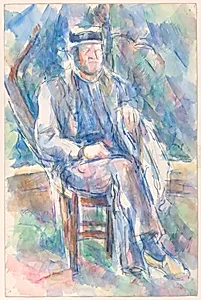
1839–1906
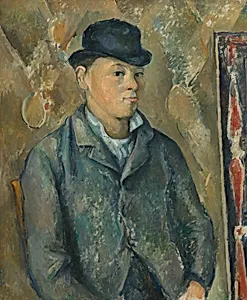
Paul Cézanne (1839–1906), born in Aix-en-Provence to a prosperous banker father, Louis-Auguste, and mother Anne-Elisabeth-Honorine Aubert, grew up in a bourgeois family that later acquired the Jas de Bouffan estate, where he painted his earliest murals. As a youth, he formed the inseparable trio "Les Trois Inséparables" with schoolmates Émile Zola and Baptistin Baille. Despite his father's wishes for a legal career, Cézanne studied drawing at the Free Municipal School of Drawing in Aix under Joseph Gibert from 1857, then briefly at the University of Aix's law faculty before pursuing art in Paris in 1861. Rejected by the École des Beaux-Arts, he honed his skills at the Académie Suisse, copying masters like Titian and Rubens at the Louvre, and later received crucial mentorship from Camille Pissarro in Pontoise and Auvers-sur-Oise during the 1870s. In 1869, he began a relationship with model Marie-Hortense Fiquet, with whom he had a son, Paul, in 1872; they married in 1886 after his father's death.
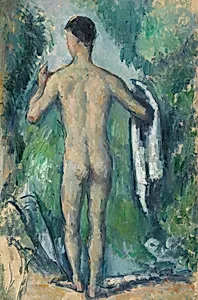
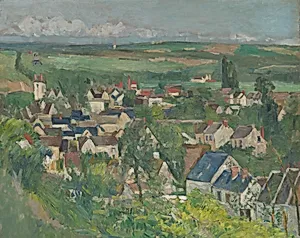
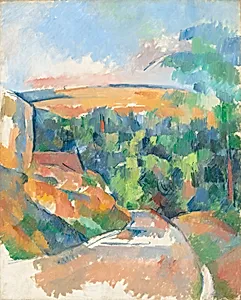
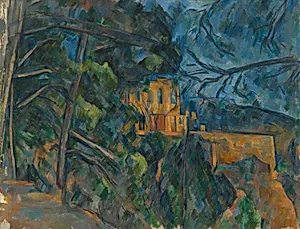
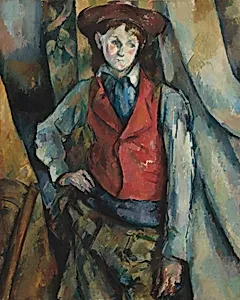
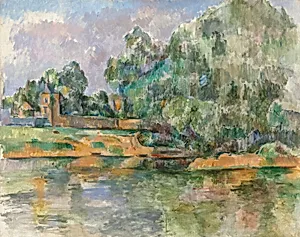
Cézanne's style evolved from the dark, Romantic Realism of his early "black period" (1860s), marked by violent contrasts and erotic themes, to Impressionism under Pissarro's influence, adopting brighter palettes and en plein air techniques. By the 1880s, as a Post-Impressionist, he rejected fleeting light effects for constructive brushwork that built forms through geometric volumes—cylinders, spheres, and cones—emphasizing underlying structure, balanced composition, and color modulation over linear perspective. Worked in the Post-Impressionist tradition, he treated the canvas as an autonomous object, synthesizing nature into "harmony parallel to nature."
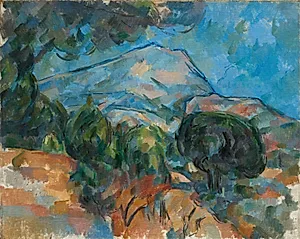
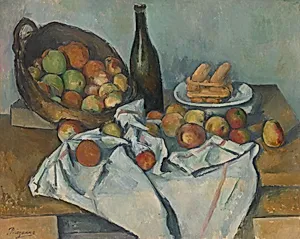
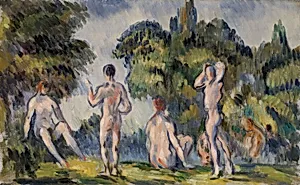
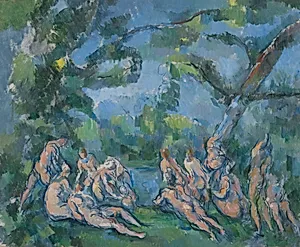
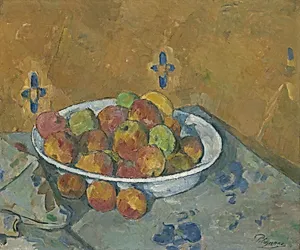
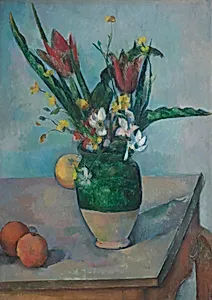
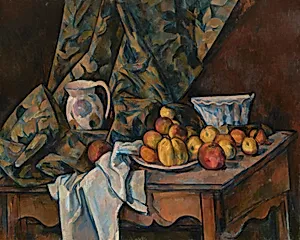
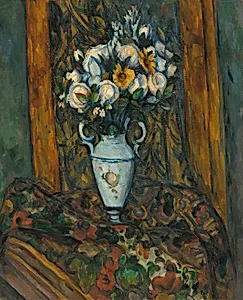
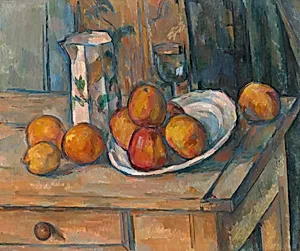
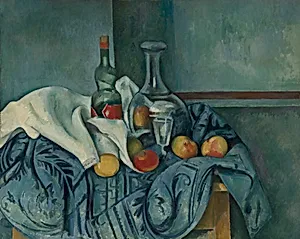
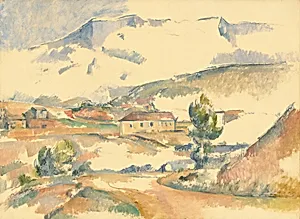
His oeuvre includes iconic series like Mont Sainte-Victoire (1885–1906, over 30 oils), obsessively capturing his Provençal homeland; The Card Players (1890–1895, five versions); Les Grandes Baigneuses (1898–1905); and still lifes such as The Basket of Apples (c. 1893–94) and Rideau, Cruchon et Compotier (1893–94). Earlier works like Portrait of Louis-Auguste Cézanne, Father of the Artist (1866) and A Modern Olympia (1873–74) showcase his maturation.
Though dismissed by critics during his lifetime, Cézanne's innovations bridged Impressionism and Cubism, earning him the title "father of us all" from Picasso and Matisse. His emphasis on form and personal vision profoundly shaped modernism, from Cubists like Braque to Abstract Expressionists, cementing his legacy as a pivotal figure in 20th-century art.