
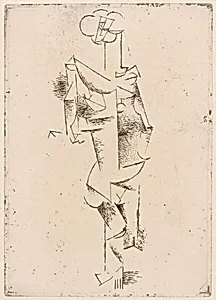
Mademoiselle Léonie, First Plate
1910
Medium
etching
Dimensions
image: 20 × 14.13 cm (7 7/8 × 5 9/16 in.) sheet: 25.88 × 22.54 cm (10 3/16 × 8 7/8 in.)
Classification
Department
CG-W
Museum
National Gallery of Art, Washington, D.C.
Credit
Rosenwald Collection
Accession Number
1964.8.1376
Rights
Public Domain
Art Historical Context
**Mademoiselle Léonie, Plate** is a striking etching by Pablo Picasso, created in1910 during his pioneering Analytic Cubist phase. At this time, Picasso, alongside Georges Braque, was revolutionizing art by deconstructing forms into geometric fragments, challenging traditional perspective and representation. This intimate print, measuring just 20 × 14.13 cm, captures the essence of a woman named Léonie—likely a or acquaintance—through angular planes and interlocking shapes, embodying Cubism's intellectual dissection of reality. As an etching, the work showcases Picasso's mastery of printmaking techniques, where acid bites into a metal plate to create precise, incisive lines. This "first plate" hints at experimental states, allowing Picasso to refine his Cubist vocabulary in a reproducible medium. Etchings like this democratized his radical ideas, making avant-garde art accessible beyond paintings. Housed in the National Gallery of Art's Rosenwald Collection, this piece exemplifies Picasso's prolific output in 1910, bridging his Rose Period lyricism with the austerity of high Cubism. Visitors will appreciate its modest scale, which invites close inspection of its innovative geometry—a testament to art's power to rethink the human form.
About the Artist
Pablo Picasso · 1881–1973
Pablo Picasso (1881–1973), born Pablo Diego José Francisco de Paula Juan Nepomuceno María de los Remedios Cipriano de la Santísima Trinidad Ruiz y Picasso in Málaga, Spain, was the son of José Ruiz Blasco, a painter and art professor who served as his first teacher. From age seven, Picasso trained under his father in figure drawing and oil painting, mastering naturalistic techniques by copying mas...