
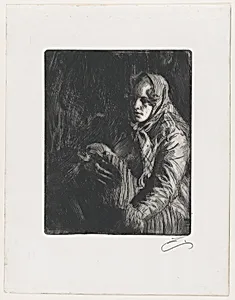
Madonna
1900
Medium
Etching; third state of four (Asplund)
Dimensions
Plate: 9 3/4 × 7 3/4 in. (24.8 × 19.7 cm) Sheet: 15 1/4 × 11 7/8 in. (38.7 × 30.1 cm)
Classification
Prints
Department
Drawings and Prints
Museum
Metropolitan Museum of Art, New York, NY
Credit
Bequest of Blanche S. Guggenheim, 1953
Accession Number
53.628.10
Rights
Public Domain
Tags
Art Historical Context
Anders Zorn's "Madonna" from 1900 is a refined etching that highlights the Swedish artist's exceptional skill in printmaking. Working in the third state of four, Zorn refined the composition through successive stages, building depth and nuance with each iteration. The intimate scale of the plate—just under ten inches high—invites close viewing, where delicate lines and tonal gradations bring the subject to life. Zorn was celebrated for his etchings, a medium that allowed him to capture light and form with remarkable spontaneity. By drawing directly on the plate and using acid to etch the lines, he achieved effects that feel both precise and alive, bridging traditional techniques with a modern sensibility. The title evokes centuries of artistic tradition centered on maternal and sacred themes, here rendered through Zorn's distinctive approach. Now part of the Metropolitan Museum of Art's Drawings and Prints collection through the bequest of Blanche S. Guggenheim, this work exemplifies the enduring appeal of etching as both an artistic and accessible medium at the dawn of the twentieth century.
About the Artist
Anders Zorn · 1860–1920
Anders Zorn (1860–1920), one of Sweden's most celebrated artists, was born on February 18 in Utmeland near Mora in Dalarna, and raised on his maternal grandparents' farm in the nearby hamlet of Yvraden. Displaying prodigious talent from a young age, he attended school in Mora Strand until age twelve, followed by secondary grammar school in Enköping, where he excelled in drawing people and horses. ...