
Madonna and Child
c. 1490
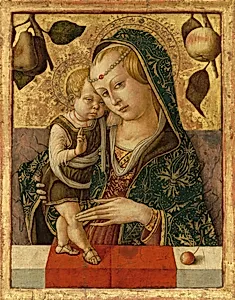
Medium
tempera on panel
Dimensions
painted surface: 32.8 x 24.7 cm (12 15/16 x 9 3/4 in.) support (includes frame, carved from single piece of wood): 39 x 30.9 cm (15 3/8 x 12 1/8 in.)
Classification
Painting
Department
CIS-R
Museum
National Gallery of Art, Washington, D.C.
Credit
Samuel H. Kress Collection
Accession Number
1939.1.264
Rights
Public Domain
Art Historical Context
Carlo Crivelli’s *Madonna and Child*, painted around 1490, exemplifies the intimate devotional works that flourished in late fifteenth-century Italy. Created in tempera on a small wooden panel—measuring just under thirteen inches high—this portable painting was likely intended for private prayer in a home or chapel. The medium’s fine detail and luminous quality allowed Crivelli to render delicate textures in the Virgin’s veil and the Christ Child’s plump limbs with remarkable precision. Although trained in the Venetian tradition, Crivelli developed a distinctive style marked by crisp contours, rich color, and often elaborate decorative elements. Here the compact format and carved wooden frame, fashioned from a single piece of wood, emphasize the work’s role as a personal object of veneration. The painting reflects the enduring importance of Marian imagery in Renaissance culture, where images of the Madonna and Child served both as aids to meditation and as expressions of piety. Acquired by the National Gallery of Art through the Samuel H. Kress Collection, this jewel-like panel continues to invite viewers into a quiet moment of spiritual connection.