
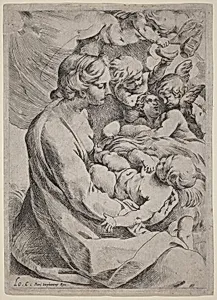
Madonna and Child with Angels
c. 1595/1610
Medium
etching and engraving
Classification
Department
CG-E
Museum
National Gallery of Art, Washington, D.C.
Credit
Ailsa Mellon Bruce Fund
Accession Number
1972.65.18
Rights
Public Domain
Art Historical Context
Lodovico Carracci’s *Madonna and Child with Angels* offers a tender vision of the Virgin Mary cradling the Christ Child, surrounded by celestial attendants. Created between roughly 1595 and 1610, this etching and engraving reflects the artist’s lifelong commitment to clear, devotional imagery. As a leading member of the Carracci family in Bologna, Lodovico helped steer Italian art away from the artificial elegance of Mannerism toward a more natural, emotionally direct style that would help shape the emerging Baroque period. The choice of printmaking is significant. Etching and engraving allowed skilled artists to produce multiple impressions, making sacred subjects available to a wider audience beyond church walls or wealthy collectors. Carracci’s fine line work and delicate modeling of forms would have translated beautifully into this medium, giving the composition both intimacy and clarity. Housed in the National Gallery of Art thanks to the Ailsa Mellon Bruce Fund, the print stands as a quiet testament to the Counter-Reformation emphasis on accessible, heartfelt religious imagery. Visitors can appreciate how Carracci balanced devotional reverence with the technical precision of early-seventeenth-century printmaking.
About the Artist
Lodovico Carracci · 1555–1619
Lodovico's style is charaterized by being less classical than that of his younger cousins, Agostino and Annibale, his figures have a sense of other-worldliness, and he is more influenced by Mannerist art than his cousins. Like his cousins, he espoused the direct study of nature, especially through figure drawing; he was influenced by the paintings of Correggio and the Venetians.