
Mail Shirt
1550/75
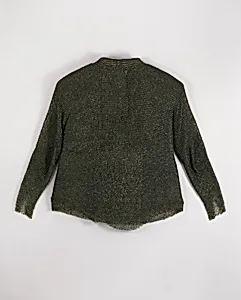
Medium
Steel, iron, and brass
Dimensions
At shoulders: W.: 67.3 cm (26 1/2 in.); H.: 91.4 cm (36 in.)
Classification
suit-element
Department
Applied Arts of Europe
Museum
Art Institute of Chicago
Accession Number
106382
Rights
Public Domain
About this artwork
Tailored to fit a sizable man, this mail shirt has heavier rings placed strategically to protect the neck and chest. The form-fitting sleeves billow out over the elbow to increase mobility. Shirts like this could have been used for fencing practice or worn for protection from bandits or assassins while traveling.
Art Historical Context
Step into the riveting world of 16th-century European armor with this exquisite *Mail Shirt*, crafted around 1550–75 by an unknown master armorer. Made from thousands of interlinked rings of steel, iron, and brass, it measures an imposing 91.4 cm in height and 67.3 cm across the shoulders—perfectly sized for a Renaissance warrior. Housed in the Art Institute of Chicago's Department of Applied Arts of Europe and classified as a suit-element, this piece exemplifies the fusion of functionality and artistry in medieval protective gear. During the Renaissance, when plate armor dominated battlefields, mail shirts like this persisted as essential underlayers or standalone defenses, offering flexible protection against slashes and thrusts. The inclusion of brass rings not only enhanced durability but also added a subtle sheen, blending practicality with aesthetic appeal. This garment reflects the era's advancing metallurgy, where skilled artisans hand-forged and riveted rings in intricate patterns to create a lightweight yet impenetrable barrier. As a highlight of applied arts, the *Mail Shirt* invites us to ponder the human ingenuity behind Europe's chivalric age—where survival met craftsmanship in every link. A testament to anonymous excellence, it transports visitors back to a time of knights, sieges, and unyielding resolve.
About the Artist
Unknown
The artist designated as "Unknown" in our virtual museum's collection exemplifies a poignant chapter in art history: creators whose identities have faded into obscurity despite the enduring power of their work. With only one known artwork attributed to them in our holdings, this figure represents countless anonymous hands that shaped visual culture across centuries. Museums worldwide, including th...