
Mairie, Loches
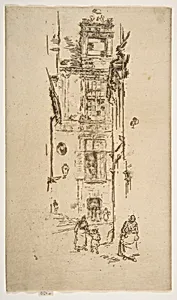
Medium
Etching and drypoint; first state of four (Glasgow); printed in black ink on fine ivory laid paper
Dimensions
Plate: 8 5/8 × 5 in. (21.9 × 12.7 cm) Sheet: 8 5/8 in. × 5 in. (21.9 × 12.7 cm)
Classification
Prints
Department
Drawings and Prints
Museum
Metropolitan Museum of Art, New York, NY
Credit
Gift of Miss Louise Veltin, 1941
Accession Number
41.124.2
Rights
Public Domain
Tags
Art Historical Context
James McNeill Whistler’s “Mairie, Loches” offers a quiet glimpse of a French town hall in 1888, rendered with the artist’s characteristic sensitivity to architecture and everyday life. Created during Whistler’s travels through the Loire Valley, the etching captures the historic buildings of Loches alongside subtle human figures, blending precise observation with an atmospheric mood typical of his European subjects. Executed in etching and drypoint as the first state of four, the print demonstrates Whistler’s meticulous working process. The fine lines and velvety burr of drypoint are printed in black ink on delicate ivory laid paper, allowing for rich tonal contrasts that emphasize both the solidity of the structures and the play of light across their surfaces. This technical refinement reflects Whistler’s central role in the nineteenth-century Etching Revival, where he elevated the medium from reproduction to a form of personal expression. Now part of the Metropolitan Museum of Art’s collection through a 1941 gift, the work invites modern viewers to appreciate Whistler’s ability to find beauty in modest civic scenes. Its intimate scale and restrained detail encourage close looking, revealing the layered textures that bring the historic town to life.
About the Artist
James McNeill Whistler · 1834–1903
James Abbott McNeill Whistler (1834-1903) was an American-born painter and printmaker who became a leading figure in the Aesthetic Movement and pioneer of Tonalism and Japonisme. He revolutionized art by championing "art for art's sake" and treating paintings as visual equivalents of musical compositions, titling works as "arrangements," "harmonies," and "nocturnes" to emphasize formal qualities o...