
Major General A. H. King
1855
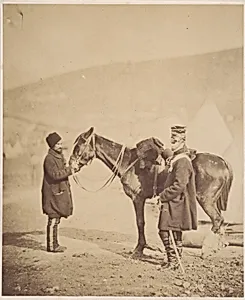
Medium
Salted paper print from glass negative
Dimensions
Image: 17.8 x 14.7 cm (7 x 5 13/16 in.) Mount: 18.3 x 15 cm (7 3/16 x 5 7/8 in.)
Classification
Photographs
Department
Photographs
Museum
Metropolitan Museum of Art, New York, NY
Credit
Gilman Collection, Museum Purchase, 2005
Accession Number
2005.100.665
Rights
Public Domain
Tags
Art Historical Context
Step into the charged atmosphere of the Crimean War with Roger Fenton's *Major General A. H.* (1855), a salted paper print capturing the steely resolve of a British commander amid one of history's first modern conflicts. Fenton, a pioneering photographer dispatched by the British press to document the war, immortalized generals like King—poised with his horse—in formal portraits that humanized the era's military elite. This 17.8 x 14.7 cm image evokes the grit of the 1853–1856 campaign, where Britain, France, and allies clashed with Russia over Black Sea territories. Fenton's work marked a turning point in photojournalism, introducing war imagery to the public through glass negatives that yielded the soft, atmospheric tones of salted paper prints. This wet-collodion process, revolutionary for its clarity and portability, allowed Fenton to haul his "photographic van" to the front lines near Sevastopol, sidestepping graphic carnage for dignified studies of leadership and loyalty. The result? A visual testament to Victorian valor, blending portraiture with propaganda. Housed in The Metropolitan Museum of Art's Gilman Collection, this print invites reflection on how early photography shaped our view of war—not as chaos, but as composed heroism. A must-see for fans of 19th-century innovation!
About the Artist
Roger Fenton · 1819–1819
Roger Fenton (1819–1869), born into a prosperous Lancashire merchant family as the son of banker and MP John Fenton, initially pursued a scholarly path, earning a first-class BA from the University of London in 1840 before studying law at University College London. He abandoned these pursuits for art, training as a painter under the history painter Charles Lucy in London by 1847—the two became clo...