
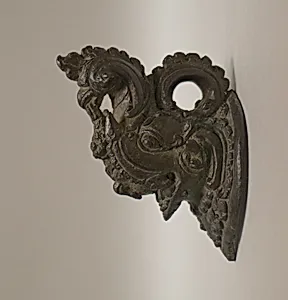
Makara-Shaped Handle
Unknown Artist
10th–11th century(?)
Medium
Bronze
Dimensions
H. 3 1/4 in. (8.3 cm); W. 3 in. (7.6 cm); D. 3 3/4 in. (9.5 cm)
Classification
Metalwork
Culture & Period
Indonesia (Java) · Eastern Javanese period
Department
Asian Art
Museum
Metropolitan Museum of Art, New York, NY
Credit
Samuel Eilenberg Collection, Gift of Samuel Eilenberg, 1987
Accession Number
1987.142.254
Rights
Public Domain
Art Historical Context
This exquisite bronze Makara-shaped handle, crafted in Java during the Eastern Javanese period (10th–11th century), exemplifies the region's masterful metalwork traditions. Measuring just 3¼ inches high, the handle depicts the mythical Makara—a composite sea creature from Hindu-Buddhist lore, blending elephant trunk, fish body, and peacock features. Likely used on a vessel, door, or ritual object, its dynamic form captures the Makara's role as a guardian of thresholds, symbolizing protection and the transition between worlds. In ancient Java, under influential Hindu-Buddhist kingdoms like the Mataram, such motifs adorned temples such as Prambanan, warding off evil and channeling auspicious energies. The bronze medium highlights advanced lost-wax casting techniques, allowing intricate details like scales, fangs, and expressive eyes that convey both ferocity and divinity. This small artifact reflects Java's cultural synthesis of Indian mythology and local artistry, thriving amid maritime trade networks. A gift from the Samuel Eilenberg Collection to The Metropolitan Museum of Art in 1987, it invites us to ponder the daily spirituality of Javanese elites, where even functional objects pulsed with cosmic symbolism.