
Burgonet
dated 1543
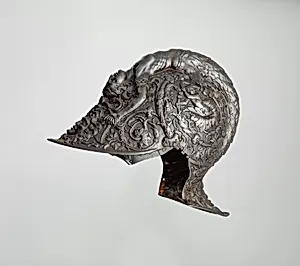
Medium
Steel, gold, textile
Dimensions
H. 9 1/2 in. (24.1 cm); W. 7 5/16 in. (18.6 cm); D. 11 1/2 in. (29.2 cm); Wt. 4 lb. 2 oz. (1871 g)
Classification
Helmets
Culture
Italian, Milan
Department
Arms and Armor
Museum
Metropolitan Museum of Art, New York, NY
Credit
Gift of J. Pierpont Morgan, 1917
Accession Number
17.190.1720
Rights
Public Domain
Tags
Art Historical Context
This magnificent burgonet, crafted in 1543 by the renowned Milanese armorer Filippo Negroli, represents the pinnacle of Renaissance armor-making. Created in Milan, then Europe’s leading center for high-quality arms and armor, the helmet was designed not merely for protection but as a statement of wealth, power, and classical learning. Negroli specialized in embossed steel that transformed functional military gear into sculptural works of art, often drawing inspiration from ancient Roman and Greek motifs. The helmet’s surface features intricate relief decoration, including the fearsome head of Medusa and playful putti, all rendered in steel and highlighted with gold. These mythological elements served both decorative and symbolic purposes, evoking protection and heroism for the wearer. The combination of steel, gold, and textile linings demonstrates the sophisticated techniques of 16th-century Italian armorers, who hammered, chased, and gilded metal with extraordinary precision. Donated to the Metropolitan Museum by J. Pierpont Morgan in 1917, this burgonet exemplifies how Renaissance armor blurred the line between warfare and fine art, reflecting the era’s revival of classical antiquity and the elevated status of its elite patrons.
About the Artist
Filippo Negroli · 1485–1605
Filippo Negroli (ca. 1510–1579) was the preeminent Milanese armorer of the Renaissance, renowned for transforming functional steel plate into sculptural masterpieces of parade armor. Born into a dynasty of armorers that traced back to the mid-fifteenth century, he was the son of Gian Giacomo Negroli (ca. 1463–1543), who led the family workshop in Milan, and worked alongside his brothers Giovan Bat...