
Making Propeller Blades
1917
Medium
lithograph
Classification
Department
CG-W
Museum
National Gallery of Art, Washington, D.C.
Credit
Rosenwald Collection
Accession Number
1943.3.6800
Rights
Public Domain
Art Historical Context
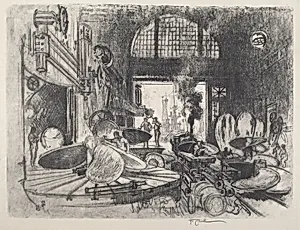
In the midst of World War I, as the United States ramped up its industrial might in 1917, Joseph Pennell captured the raw energy of wartime production in his lithograph *Making Propeller Blades*. Pennell, a master printmaker renowned for his dynamic depictions of modern machinery and urban landscapes, portrayed the gritty labor of forging airplane propellers—essential components for the emerging age of aerial warfare. This print reflects America's transformation into an "Arsenal of Democracy," highlighting the fusion of human ingenuity and mechanical power during a pivotal global conflict. Pennell's lithographic technique shines here, with its bold lines and dramatic contrasts achieved through greasy crayon on limestone, allowing for rich tonal variations and multiple impressions. A key figure in the American print revival, he drew inspiration from Whistler and the Industrial Revolution, infusing everyday factories with epic scale. Housed in the National Gallery of Art's Rosenwald Collection, this work exemplifies how prints democratized art, bringing the drama of industry to wide audiences. Fun fact: Pennell produced over 900 lithographs in his career, often sketching on-site amid roaring engines, embodying the era's fascination with progress amid peril. A testament to resilience and innovation!
About the Artist
Joseph Pennell · 1857–1926
Joseph Pennell (1857–1926) was born in Philadelphia to Quaker parents and displayed an early aptitude for drawing, finding solace in sketching amid a challenging childhood. He received initial drawing instruction from James R. Lambdin and his first etching lessons from Stephen Ferris in 1879. Pennell attended night classes at the Pennsylvania Museum and School of Industrial Art before studying at ...