
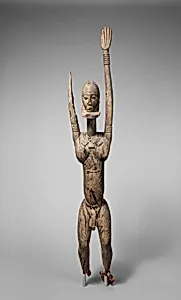
Male Figure with Raised Arms
14th–17th century
Medium
Wood, patina
Dimensions
H. 82 7/8 x W. 14 1/4 x D. 8 3/8 in. (210.5 x 36.2 x 21.3 cm)
Classification
Wood-Sculpture
Culture
Dogon peoples
Department
Arts of Africa, Oceania, and the Americas
Museum
Metropolitan Museum of Art, New York, NY
Credit
The Michael C. Rockefeller Memorial Collection, Gift of Nelson A. Rockefeller, 1969
Accession Number
1978.412.322
Rights
Public Domain
Tags
Art Historical Context
This striking wooden sculpture, titled *Male Figure with Raised Arms*, was crafted by a Dogon blacksmith between the14th and 17th centuries. Hailing from the Dogon peoples of Mali in West Africa, it stands an impressive 82⅞ inches tall, carved from wood and developed a rich patina over centuries of ritual use. Dogon blacksmiths held a revered status in their society, often channeling mystical forces into their works, blending ironworking prowess with woodworking to create objects imbued with spiritual power. The figure's dynamic pose—nude male form with arms raised—exemplifies Dogon abstract style, characterized by elongated proportions, geometric simplification, and symbolic gestures. Such sculptures typically served on ancestor altars or in ceremonies tied to the Dogon's complex cosmology, invoking protection, fertility, or harmony with the spirits. The raised arms may evoke supplication or communal dance, reflecting the culture's emphasis on balance between humans, ancestors, and the natural world. Now in the Metropolitan Museum of Art's Arts of Africa, Oceania, and the Americas department, this piece from The Michael C. Rockefeller Memorial Collection offers a window into pre-colonial Dogon artistry, where form meets profound cultural symbolism.