
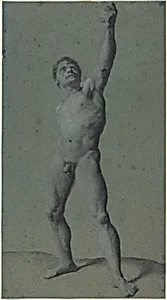
Male Nude Study
1751 to 1775
Medium
charcoal heightened with white chalk on blue paper
Dimensions
overall: 45.3 x 25 cm (17 13/16 x 9 13/16 in.)
Classification
Drawing
Department
CG-E
Museum
National Gallery of Art, Washington, D.C.
Credit
Gift of Howard Sturges
Accession Number
1956.9.11
Rights
Public Domain
Art Historical Context
Pierre-Paul Prud'hon’s *Male Nude Study* offers a sensitive exploration of the human form, created during the artist’s formative years between 1751 and 1775. Working in France at a time when artists looked to classical antiquity for inspiration, Prud’hon used this drawing to examine anatomy, balance, and the play of light across the body. The result is both a technical exercise and a quietly poetic image that reflects the period’s renewed interest in idealized yet lifelike figures. The choice of charcoal heightened with white chalk on blue paper is especially effective here. The blue sheet acts as a middle tone, allowing the artist to build soft shadows with charcoal while adding luminous highlights with chalk. This traditional technique gives the study a sculptural quality, making the figure appear to emerge from the page with gentle volume and movement. At just 45.3 by 25 centimeters, the drawing rewards close viewing, revealing the delicate transitions Prud’hon achieved through careful layering. Now part of the National Gallery of Art’s collection through the generosity of Howard Sturges, the work provides a window into the private practice of an artist celebrated for both his paintings and his drawings. It reminds visitors that even seemingly simple studies can embody the grace and refinement central to late-eighteenth-century French art.
About the Artist
Pierre Paul Prud'hon · 1758–1823
Pierre Paul Prud'hon (1758–1823) was a French painter and draughtsman whose dreamy, sensuous art occupied a singular position between the Neoclassicism and Romanticism that competed for dominance in French painting around 1800. Born in Cluny in Burgundy, he received his early artistic training at the Dijon Academy before winning the Prix de Rome of the Estates of Burgundy, which allowed him to spe...