
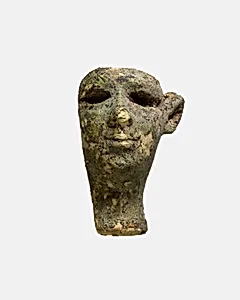
Male (originally red) head for composite statuette
Unknown Artist
664–30 B.C.
Medium
Glass
Dimensions
H. 4.3 × W. 2.8 × T. 2.8 cm (1 11/16 × 1 1/8 × 1 1/8 in.)
Classification
Insert, man's head
Period
Late Period–Ptolemaic Period
Department
Egyptian Art
Museum
Metropolitan Museum of Art, New York, NY
Credit
Gift of J. Pierpont Morgan, 1917
Accession Number
17.194.2465
Rights
Public Domain
Tags
Art Historical Context
This delicate glass head, originally vibrant red, once formed part of a composite statuette from ancient Egypt's Late Period to Ptolemaic era (664–30 B.C.). Measuring just 4.3 cm high, it depicts a male figure with finely modeled features—smooth contours, a broad face, and an expression of quiet dignity. Crafted for assembly with a body of other materials like wood or faience, such heads were common in votive figures placed in household shrines or tombs, embodying ancestors, deities, or protective spirits. Egyptian glassmaking reached sophisticated heights during this time, blending traditional techniques with Ptolemaic innovations after Greek rule. Artisans likely used core-forming or molding methods, infusing the glass with copper oxides for its striking red hue, which has faded over millennia. This small-scale work highlights the culture's mastery of color and translucency, rivaling more precious stones. Today, housed in the Metropolitan Museum of Art's Egyptian Art department as a gift from J. Pierpont Morgan in 1917, it offers a glimpse into everyday devotion and artistry. Imagine it atop a statuette, glowing in temple lamplight—a testament to Egypt's enduring fusion of technology and spirituality.