
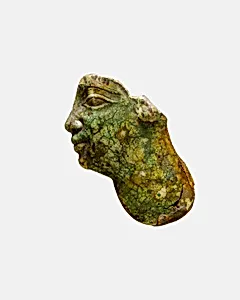
Profile face inlay
Unknown Artist
570–30 BC
Medium
Red glass decayed to green
Dimensions
H. 3.6 × W. 2.6 cm (1 7/16 × 1 in.)
Classification
Inlay, profile head
Period
Late Period–Ptolemaic Period
Department
Egyptian Art
Museum
Metropolitan Museum of Art, New York, NY
Credit
Purchase, Fletcher Fund and The Guide Foundation Inc. Gift, 1966
Accession Number
66.99.186
Rights
Public Domain
Tags
Art Historical Context
This delicate *Profile Face Inlay* is a captivating glimpse into ancient Egyptian artistry from the Late Period to Ptolemaic era (570–30 BC). Crafted from red glass that has naturally decayed to a striking green patina over millennia, this tiny piece measures just 3.6 × 2.6 cm, yet exemplifies the precision of Egyptian craftsmen. Likely intended for embedding in jewelry, furniture, or ritual objects like mummy masks, its sharp profile view adheres to the iconic conventions of Egyptian portraiture, where the face is rendered in strict profile to convey eternity and order. Glassmaking reached sophisticated heights in ancient Egypt during this time, with artisans using copper impurities to achieve vibrant reds for inlays—materials prized for their durability and jewel-like sheen, rivaling semi-precious stones. The decay to green, caused by chemical reactions with burial moisture and soil, is a common fate for such artifacts, adding a layer of archaeological intrigue. Produced amid Egypt's transitions under Persian and Greek rule, it reflects enduring native traditions blending functionality with symbolic power. Today, this gem resides in the Metropolitan Museum of Art's Egyptian Art collection, acquired through the Fletcher Fund and The Guide Foundation Inc. Gift in 1966. Its miniature scale invites wonder at the skill required to capture human features so vividly, offering visitors a personal portal to a civilization's masterful gaze upon the divine.