
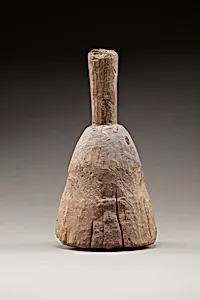
Mallet
Unknown Artist
ca. 1200–30 B.C.
Medium
Wood
Dimensions
L. 27.6 × Dia. 16.5 cm (10 7/8 × 6 1/2 in.); Dia. 4.3 cm (Handle) (1 11/16 in.)
Classification
Mallet
Period
New Kingdom–Ptolemaic
Department
Egyptian Art
Museum
Metropolitan Museum of Art, New York, NY
Credit
Rogers Fund and Edward S. Harkness Gift, 1913
Accession Number
13.180.30
Rights
Public Domain
Art Historical Context
This wooden mallet, dating to around 1200–1030 B.C., hails from Egypt's New Kingdom period, specifically Dynasty 20 or later—a time of grand pharaonic achievements under rulers like Ramesses III, amid the twilight of the empire's power. Measuring about 27.6 cm long with a head diameter of 16.5 cm and a slender 4.3 cm handle, it exemplifies the practical craftsmanship of ancient Egyptian artisans. Wood, a precious material often imported from regions like Lebanon due to Egypt's scarcity of native hardwoods, was meticulously shaped here into a sturdy tool for pounding, shaping stone, or woodworking tasks essential to temple construction and daily life. Though utilitarian, this mallet offers a rare glimpse into the tools that powered Egypt's monumental legacy. Surviving examples like this are uncommon, as organic materials typically decayed in the Nile's humid climate unless preserved in arid tombs or dry sands. Its simple, functional form highlights the Egyptians' masterful woodworking techniques, achieved without metal tools in many cases. Acquired through the Rogers Fund and Edward S. Harkness Gift in 1913, this artifact now resides in the Metropolitan Museum of Art's Egyptian Art department. It invites visitors to ponder the hands behind the pyramids—skilled laborers whose everyday implements bridged the divine and the mortal worlds.