
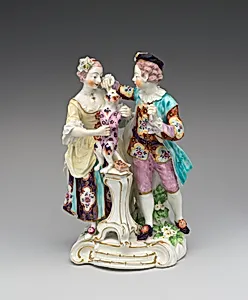
Man and girl with dog dressed as harlequin
ca. 1765
Medium
Soft-paste porcelain
Dimensions
Height: 10 1/8 in. (25.7 cm)
Classification
Ceramics-Porcelain
Culture
British, Derby
Department
European Sculpture and Decorative Arts
Museum
Metropolitan Museum of Art, New York, NY
Credit
Gift of Mrs. Francis P. Garvan, in memory of Francis P. Garvan, 1952
Accession Number
52.192.2
Rights
Public Domain
Tags
Art Historical Context
This charming porcelain figurine, *Man and Girl with Dog Dressed as Harlequin*, crafted by the Derby Porcelain Manufactory around 1765, captures a whimsical moment of companionship and play. Standing at just over 10 inches tall, the soft-paste porcelain group depicts a man and young girl with their lively dog costumed as the mischievous harlequin from commedia dell'arte theater—a nod to popular 18th-century entertainment. The detailed modeling brings the figures to life, with the dog's colorful diamond-patterned outfit adding a touch of theatrical flair. Derby, a leading British porcelain center in the mid-1700s, excelled in producing these figurative groups, blending European innovation with influences from Chinese and Meissen wares. Soft-paste porcelain, made from clay mixed with ground glass and fired at lower temperatures, allowed for the factory's signature vibrant enamel colors and intricate gilding, though it was more fragile than later hard-paste formulas. These pieces adorned affluent homes as decorative delights, reflecting the era's fascination with pastoral innocence and lighthearted vignettes. Now in the Metropolitan Museum of Art's European Sculpture and Decorative Arts collection, this work exemplifies Derby's artistic peak before its 1770s merger with Chelsea porcelain. It invites visitors to appreciate the delicate artistry that turned everyday scenes into enduring treasures.
About the Artist
Derby Porcelain Manufactory · 1751–1785
The Derby Porcelain Manufactory stands as one of the foundational institutions of British ceramic art, producing some of the finest figures and tablewares made in England during the eighteenth and early nineteenth centuries. Its origins can be traced to the work of André Planché, a Huguenot immigrant from Saxony who settled in Derby around 1745 and began producing soft-paste porcelain figures and ...