
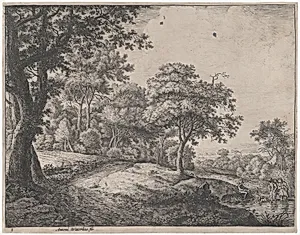
Man and Woman Crossing a Stream
17th century
Medium
Etching; first state of four
Dimensions
sheet: 8 11/16 x 11 1/4 in. (22.1 x 28.5 cm)
Classification
Prints
Department
Drawings and Prints
Museum
Metropolitan Museum of Art, New York, NY
Credit
Gift of Kenneth Grebinar, 2005
Accession Number
2005.377.37
Rights
Public Domain
Tags
Art Historical Context
Step into the tranquil world of17th-century Dutch landscape with *Man and Woman Crossing a Stream*, exquisite etching by Anthonie Waterloo (c. 1609–1690). Created during the Dutch Golden Age, this print captures a pastoral moment: a man and woman carefully ford a gentle stream, framed by lush trees that evoke the harmonious bond between humanity and nature. Waterloo, a master etcher influenced by Rembrandt and Hercules Seghers, specialized such evocative outdoor scenes, blending meticulous detail with atmospheric depth. As a first-state etching—one of four progressive states—this impression preserves the artist's purest lines and tones before later refinements. Etching, an intaglio technique where acid bites into a metal plate to create intricate textures, allowed Waterloo to render shimmering water, leafy foliage, and subtle figures with remarkable precision. Measuring 8 11/16 x 11 1/4 inches, its intimate scale invites close contemplation, highlighting the medium's role in democratizing fine art through affordable prints. Now housed in the Metropolitan Museum of Art's Drawings and Prints department (gift of Kenneth Grebinar, 2005), this work exemplifies the era's fascination with everyday rural life amid Holland's burgeoning interest in topography and the sublime landscape. A gem for print enthusiasts, it whispers of timeless serenity.
About the Artist
Anthonie Waterloo · 1609–1690
Anthonie Waterloo (1609–1690) was a prominent Dutch Golden Age landscape artist, born on May 6 in Lille, then part of the Spanish Netherlands. Little is known of his early life beyond his mother, Magdalena Vaillant, who joined Amsterdam's Walloon Church in 1621, with Waterloo following in 1630; no records exist of formal training, and he was likely self-taught. Registered as a painter in Amsterdam...