
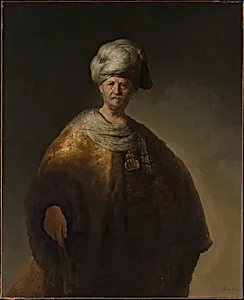
Man in a Turban
Medium
Oil on canvas
Dimensions
60 1/16 × 48 15/16 in. (152.6 × 124.3 cm)
Classification
Paintings
Department
European Paintings
Museum
Metropolitan Museum of Art, New York, NY
Credit
Bequest of William K. Vanderbilt, 1920
Accession Number
20.155.2
Rights
Public Domain
Tags
Art Historical Context
Rembrandt van Rijn's *Man in a Turban* (1632) is a striking oil-on-canvas portrait that captures the artist's early mastery during the Dutch Golden Age. At just 26 years old, Rembrandt painted this life-sized work (60 1/16 × 48 15/16 in.), showcasing his signature Baroque style through dramatic chiaroscuro—the bold interplay of light and shadow that draws the eye to the subject's intense gaze and richly textured turban. This "tronie," a Dutch term for an expressive character study rather than a specific portrait, reflects the era's fascination with exotic costumes and faces, evoking Eastern influences amid Europe's expanding trade networks. The painting's significance lies in Rembrandt's innovative use of oil, allowing velvety brushwork and luminous highlights that convey psychological depth and realism. His loose, impasto technique in the fabrics contrasts with the finely rendered face, pulling viewers into an intimate encounter with an anonymous sitter. Acquired through the 1920 bequest of William K. Vanderbilt, it now graces the Metropolitan Museum of Art's European Paintings collection. This timeless work highlights Rembrandt's genius for elevating everyday subjects into profound human studies, inviting us to ponder the man's story across centuries.
About the Artist
Rembrandt (Rembrandt van Rijn) · 1606–1669
Rembrandt Harmenszoon van Rijn (1606–1669) stands as one of the greatest visual artists in the history of Western art and the most important Dutch painter of the 17th century. Born in Leiden to a prosperous miller's family, Rembrandt transformed painting through his revolutionary use of light and shadow, his psychological depth in portraiture, and his elevation of etching to a fine art. His approx...