
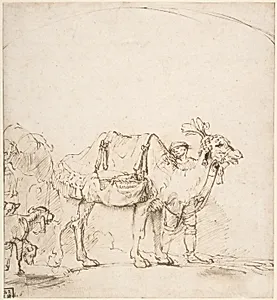
Man Leading a Camel
Medium
Pen and brown ink, traces of brush and brown wash
Dimensions
sheet: 8 1/16 x 7 7/16 in. (20.5 x 18.9 cm)
Classification
Drawings
Department
Drawings and Prints
Museum
Metropolitan Museum of Art, New York, NY
Credit
Rogers Fund, 1908
Accession Number
08.227.36
Rights
Public Domain
Tags
Art Historical Context
In the heart of Rembrandt van Rijn's prolific drawing practice comes *Man Leading a Camel*, captivating sheet from around 1650–69. Created during the Dutch master's mature years in Amsterdam, this work exemplifies his mastery of pen and brown ink, with subtle traces of brush and brown adding depth and texture. Measuring just 8 1/16 x 7 7/16 inches, its intimate scale invites close contemplation, much like the rapid sketches Rembrandt produced in his studio to capture movement and form. Rembrandt, a towering figure of the Baroque era, was renowned for his expressive drawings that bridged everyday observation with imaginative storytelling. Here, the fluid lines of the pen trace the camel's swaying gait and the man's purposeful stride, evoking an exotic encounter—perhaps inspired by biblical narratives or tales from the Orient, as suggested by the tags of "Men" and "Camels." The brown wash hints at shadow and volume, showcasing Rembrandt's innovative use of minimal media to achieve lifelike vitality, a technique that influenced generations of artists. Acquired through the Rogers Fund in 1908 and now housed in the Metropolitan Museum of Art's Drawings and Prints department, this piece reveals Rembrandt's endless curiosity for the human-animal bond. It's a window into 17th-century Europe's fascination with distant worlds, rendered with the artist's signature empathy and precision.
About the Artist
Rembrandt (Rembrandt van Rijn) · 1606–1669
Rembrandt Harmenszoon van Rijn (1606–1669) stands as one of the greatest visual artists in the history of Western art and the most important Dutch painter of the 17th century. Born in Leiden to a prosperous miller's family, Rembrandt transformed painting through his revolutionary use of light and shadow, his psychological depth in portraiture, and his elevation of etching to a fine art. His approx...