
Man Leading a Horse (recto); Study of a Man (verso)
1910
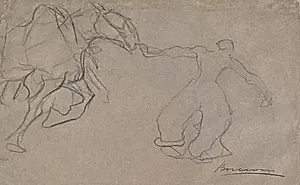
Medium
Graphite on paper
Dimensions
4 1/2 x 7 in. (11.4 x 17.8 cm)
Classification
Drawings
Department
Modern and Contemporary Art
Museum
Metropolitan Museum of Art, New York, NY
Credit
Bequest of Lydia Winston Malbin, 1989
Accession Number
1990.38.17ab
Rights
Public Domain
Tags
Art Historical Context
Umberto Boccioni, a leading voice in the Italian Futurist movement, created this modest graphite drawing in 1910, just as Futurism was challenging traditional notions of art with its celebration of speed, technology, and dynamic energy. The recto shows a man leading a horse, while the verso offers a study of a male figure—both rendered in quick, economical strokes typical of an artist capturing fleeting impressions. At just 4½ by 7 inches, the sheet feels intimate, like a page from a sketchbook where ideas were tested before larger paintings. As a work on paper, it highlights Boccioni’s process during a pivotal moment when he was moving from Divisionist influences toward the fragmented forms that would define Futurism. Drawings like this one reveal how the artist explored movement and human-animal interaction, themes that would soon appear in his more famous paintings and sculptures. The simple medium allows the viewer to sense the directness of his hand and the restless energy of early 20th-century modernism. Today in the Metropolitan Museum’s collection, the drawing offers a rare glimpse into Boccioni’s creative thinking, reminding us that even revolutionary ideas often began with pencil on paper.
About the Artist
Umberto Boccioni · 1882–1916
Umberto Boccioni (1882–1916) was an Italian painter and sculptor who became the leading artist and principal theorist of the Futurist movement. Born in Reggio Calabria, he studied in Rome under the Divisionist painter Giacomo Balla and was deeply influenced by Post-Impressionism before encountering the ideas of Filippo Tommaso Marinetti, whose 1909 Futurist Manifesto catalyzed Boccioni's artistic ...