
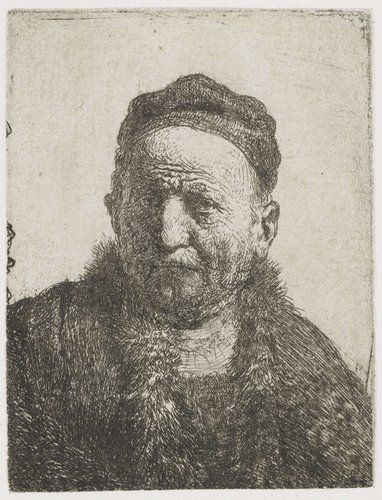
Man met kalotje: buste; de vader van Rembrandt (?)
Medium
etching
Dimensions
61; 80
Rights
Public Domain
About this artwork
mark: Lugt 2228
Art Historical Context
This intimate etching, *Man met kalotje: buste; de vader van Rembrandt (?)—* or "Man with Skullcap: Bust; Rembrandt's Father(?)," captures a thoughtful portrait from 1630, created by the young Rembrandt van Rijn at age 24. Measuring just 80mm by 61mm, it's a modest yet masterful work from his early Leiden period, when he was honing his skills before moving to Amsterdam. The subject tentatively identified as Rembrandt's, Harmen Gerrits van Rijn, wears traditional skullcap, ev the sober piety of 17th-century burghers. Rembrandt's etching technique shines here: he drew fine lines into a copper plate with acid-resistant ground, then submerged it in acid to "bite" the lines, creating delicate textures and subtle tonal depths. This innovative drypoint-etching hybrid allowed for rich contrasts, foreshadowing his later masterpieces like *The Hundred Guilder Print*. The Lugt 2228 collector's mark hints at its esteemed provenance, underscoring its value among connoisseurs. As an early experiment in portraiture, this bust reveals Rembrandt's emerging genius for psychological depth in miniature form—a poignant glimpse into his family life amid the Dutch Golden Age's artistic ferment. Visitors, imagine holding this tiny treasure: a father's gaze frozen in time by his prodigal son.
About the Artist
Rembrandt van Rijn · 1606–1669
Rembrandt Harmenszoon van Rijn (1606–1669) stands as one of the greatest visual artists in the history of Western art and the most important Dutch painter of the 17th century. Born in Leiden to a prosperous miller's family, Rembrandt transformed painting through his revolutionary use of light and shadow, his psychological depth in portraiture, and his elevation of etching to a fine art. His approx...