
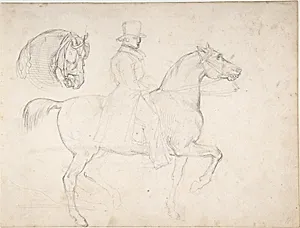
Man on Horseback, and Study of Horse's Head
19th century
Medium
Black chalk
Dimensions
8 7/16 x 11 1/8 in. (21.4 x 28.2 cm)
Classification
Drawings
Department
Drawings and Prints
Museum
Metropolitan Museum of Art, New York, NY
Credit
Bequest of Walter C. Baker, 1971
Accession Number
1972.118.215
Rights
Public Domain
Tags
Art Historical Context
Théodore Géricault *Man on Horseback, Study of Horse's Head is a captivating 19th-century drawing in black chalk, measuring just 8 7/16 x 11 1/8 inches. Housed in the Metropolitan Museum of Art's Department of Drawings and Prints, intimate sheet—bequeathed by Walter C. Baker in1971—showcases Géricault's masterful command of the human and equine form. The composition juxtaposes a dynamic rider astride a powerful horse with a detailed close-up study of the animal's head, highlighting the artist's keen observation of anatomy and movement. As a leading figure in French Romanticism, Géricault was renowned for his dramatic depictions of horses, often drawn from life at stables and slaughterhouses to capture raw energy and emotion. Black chalk, with its rich tonal range and fluid lines, was ideal for these rapid preparatory sketches, allowing him to explore volume, musculature, and tension—techniques that informed his monumental paintings like *The Raft of the Medusa*. This work exemplifies his obsession with equestrian themes, blending heroic masculinity with the nobility of the horse, symbols of vitality in Romantic art. For visitors, this drawing offers a glimpse into Géricault's creative process, revealing how meticulous studies fueled his revolutionary style. Its modest scale belies its intensity, inviting you to trace the bold contours and subtle shading that breathe life into man and beast.
About the Artist
Théodore Gericault · 1791–1824
Théodore Géricault, born Jean-Louis André Théodore Géricault on September 26, 1791, in Rouen, France, into a prosperous family—his father a lawyer turned tobacco merchant and his mother from a line of growers—moved to Paris around 1797. Displaying early artistic promise, recognized by painter Jean-Louis Laneuville, he began formal training in 1808 under Carle Vernet, mastering English sporting art...