
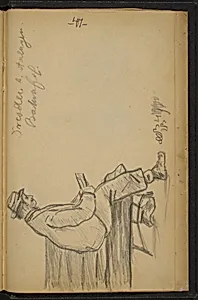
Man Seated at the End of a Bench, Reading
1900
Medium
graphite on wove paper
Classification
Drawing
Department
CG-W
Museum
National Gallery of Art, Washington, D.C.
Credit
Gift of Mrs. Max Beckmann
Accession Number
1984.64.64.161
Rights
Public Domain
Art Historical Context
In the quiet intimacy of *Man Seated at the End of a Bench Reading* (1900), Max Beckmann captures a solitary figure lost in contemplation, perched at the bench's edge with a book in hand. Created when Beckmann was a young artist at the dawn of the 20th, this graphite drawing on wove paper reflects the observational precision typical of early modern draftsmen honing their craft amid Germany's vibrant artistic scene. Beckmann would later become a towering figure in German Expressionism, known for his bold, distorted forms and psychological depth, but this early work reveals his roots in naturalistic depiction. The everyday subject—a lone reader—hints at the artist's fascination with human isolation and urban solitude, themes that would evolve dramatically in his mature oeuvre. Rendered in graphite on smooth wove paper, the medium lends itself to delicate tonal gradations and fine lines, emphasizing light, shadow, and subtle textures. A thoughtful gift from Mrs. Max Beckmann to the National Gallery of Art, this drawing offers visitors a glimpse into the foundational sketches that propelled one of modernism's most provocative voices.
About the Artist
Max Beckmann · 1884–1950
Max Carl Friedrich Beckmann (1884-1950) stands as one of the most significant German painters of the twentieth century, a complex artist who bridged Expressionism and the New Objectivity while forging a deeply personal visual language. Born in Leipzig into a middle-class family, Beckmann's artistic journey spanned from academic classicism through the traumatic crucible of World War I to a mature s...