
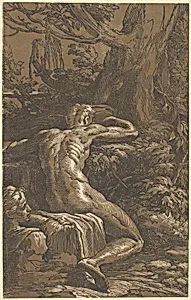
Man seated viewed from behind (Narcissus)
Medium
Chiaroscuro woodcut printed from two blocks in brown
Dimensions
Sheet: 14 7/8 × 11 1/4 in. (37.8 × 28.5 cm) Plate: 11 5/16 × 7 3/8 in. (28.8 × 18.8 cm)
Classification
Prints
Department
Drawings and Prints
Museum
Metropolitan Museum of Art, New York, NY
Credit
Rogers Fund, 1922
Accession Number
22.73.3-44
Rights
Public Domain
Tags
Art Historical Context
In the late 1520s, the Mannerist master Parmigianino (Girolamo Francesco Mazzola) collaborated with woodcutter Antonio da to create this striking *Man Seated Viewed from Behind (arcissus)*, a chiaroscuro wood printed from two brown blocks around 1527–30. Depicting the mythological youth Narcissus from behind, gazing perhaps at his reflection, the image captures a nude male figure in a contemplative pose, evoking the classical tale of self-absorbed beauty from Ovid's *Metamorphoses*. Housed in the Metropolitan Museum of Art's Drawings and Prints department, this 14⅞ × 11¼ in. sheet exemplifies Renaissance innovation in printmaking. The chiaroscuro technique—using one block for line and another for tone—mimics the dramatic light-and-shadow effects of painting, elevating woodcuts beyond mere outlines into sculptural, three-dimensional forms. Parmigianino's elegant, elongated proportions and graceful contours reflect his signature Mannerist style, which prized artifice and refinement over High Renaissance naturalism. This method, rare for woodcuts at the time, allowed affordable dissemination of sophisticated designs to a wider audience. one of the earliest and finest examples of collaborative chiaroscuro prints, it highlights the creative synergy between artist and craftsman in 16th-century Italy, bridging painting and print cultures while celebrating the male nude's classical ideal. A captivating study in introspection and beauty, it invites viewers to ponder Narcissus's eternal gaze.
About the Artist
Antonio da Trento|Parmigianino (Girolamo Francesco Maria Mazzola) · 1500–1560
Antonio da Trento (c. 1508–1550) was an Italian printmaker who specialized in chiaroscuro woodcuts, a sophisticated printing technique that used multiple woodblocks to create images with tonal depth and atmospheric effects. Working during the height of the Italian Renaissance, Antonio was one of a small group of master printmakers—including Ugo da Carpi, Niccolò Vicentino, and Nicolò Boldrini—who ...