
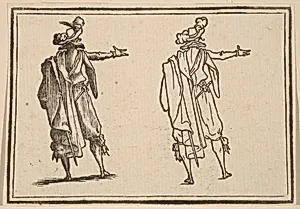
Man Seen from Behind with His Right Arm Extended
Medium
woodcut on laid paper
Dimensions
sheet (trimmed to block): 6 × 8.6 cm (2 3/8 × 3 3/8 in.)
Classification
Department
CG-E
Museum
National Gallery of Art, Washington, D.C.
Credit
R.L. Baumfeld Collection
Accession Number
1969.15.212
Rights
Public Domain
Art Historical Context
"Man Seen from Behind with His Arm Extended" is a woodcut on laid paper from 1621, created by Edouard Eckman the renowned French printmaker Jacques Callot. just 6 × 8.6 cm—trimmed precisely to the block—this intimate print captures a solitary male figure viewed from behind, his right arm outstretched in a gesture that evokes motion and narrative potential. Housed in the National Gallery Art's R.L. Baumfeld Collection, it exemplifies the era's fascination with human form and expression. Jacques Callot (1592–1635), a Baroque master, revolutionized printmaking with his intricate, small-scale compositions, often depicting everyday life, theater, and war. Though Eckman executed this woodcut—a relief printing technique where the artist carves away negative space from a wood block, inks the raised surface, and presses it onto paper— it faithfully reproduces Callot's precise draftsmanship. Woodcuts on laid paper, identifiable by its subtle chain lines, were prized for their affordability and reproducibility, allowing art to reach wider audiences beyond elite patrons. This modest yet evocative study highlights the 17th-century shift toward naturalistic figure rendering, possibly drawn from life models or theatrical poses. Its compact size invites close contemplation, revealing Callot's genius for storytelling in miniature—a testament to printmaking's role in democratizing visual culture during Europe's artistic golden age.
About the Artist
Edouard Eckman after Jacques Callot
Edouard Eckman, a Flemish printmaker born around 1600, remains a somewhat enigmatic figure in art history, with his early life not well documented. Little is known about his training or formal education, though his oeuvre suggests familiarity with the vibrant printmaking traditions of the early Baroque period in Northern Europe. Active primarily in the second decade of the seventeenth century, Eck...