
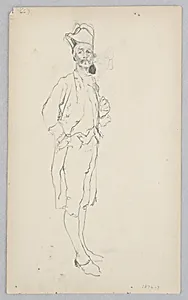
Man
Classification
figures
Department
Smithsonian Collection
Museum
Smithsonian American Art Museum
Credit
Gift of Henrietta Haller
Accession Number
1904-16-119
Rights
Public Domain
About this artwork
Research in Progress
Art Historical Context
"Man" (1876–1877) is an early work by Robert Frederick, a prominent American artist born in Cincinnati in 1857. Created when Blum was just 19 or 20 years old, piece captures the nascent talent of a painter who would go on to gain fame for his genre scenes, portraits, intricate watercolor techniques influenced by both American realism and later Japanese aesthetics. Classified as a figure study, it likely explores the human form during a pivotal era in American art—the post-Civil War years, when artists began shifting from rigid academic traditions toward more naturalistic depictions of everyday life. Though the medium remains unidentified amid ongoing research at the Smithsonian American Art Museum, the work's focus on a single male figure reflects the era's interest in character studies and portraiture, which allowed artists like Blum to hone their skills in capturing expression and anatomy. Blum's early training at the McMicken School of Design in Cincinnati laid the groundwork for his lifelong pursuit of light, texture, and narrative depth. Acquired as a gift from Henrietta Haller and housed in the Smithsonian Collection, "Man" offers a glimpse into Blum's formative years before his travels to Venice and Japan elevated his international reputation. Visitors are invited to ponder its quiet intensity, a testament to the artist's emerging voice in 19th-century American figure painting. (198 words)