
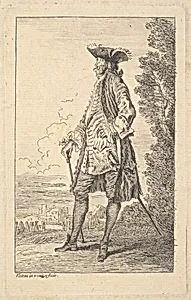
Man walking and carrying a cane in his right hand, shown in three-quarters view with his head turned away from the viewer, from "Figures of Fashion" (Figures de Modes)
ca. 1710
Medium
Etching
Dimensions
sheet: 7 13/16 x 5 13/16 in. (19.8 x 14.8 cm) plate: 5 1/16 x 3 1/8 in. (12.8 x 8 cm)
Classification
Prints
Department
Drawings and Prints
Museum
Metropolitan Museum of Art, New York, NY
Credit
Bequest of Phyllis Massar, 2011
Accession Number
2012.136.74.3
Rights
Public Domain
Tags
About this artwork
Antoine Watteau (1684-1721), the French master who revitalized the Baroque style and pioneered the Rococo movement, created this elegant fashion plate etching around 1710 as part of his "Figures de Modes" series. Unusually for Watteau, he both drew and etched these plates himself before they were lightly reworked by engraver Simon Thomassin the Younger for publication. The series consisted of seven etchings showing fashionably dressed men and women of the 1710s, created when Paris was establishi...
Art Historical Context
Antoine Watteau (1684–1721), the French artist who bridged Baroque grandeur with the playful elegance of Rococo, crafted this etching around 1710 as part of his rare "Figures de Modes". Paris in the 1710s was buzzing as Europe's fashion epicenter, and Watteau captured its stylish spirit in seven prints featuring elegantly dressed men and women.usually hands-on, he both drew and etched these himself—lightly touched up by engraver Simon Thomassin the—showcasing his precise, fluid line work. This plate shows a gentleman striding forward in three-quarters view, his head turned coyly away, cane in his right hand as a mark of refined status. The etching's intimate scale (plate: 5 1/16 x 3 1/8 in.) highlights Watteau's masterful observation of contemporary dress, from flowing coats to poised postures, blending grace with subtle movement. At a pivotal moment in his career, these prints boosted Watteau's fame—his name even graces the title—while spreading Parisian trends across Europe. They exemplify his linear finesse and refinement, foreshadowing Rococo's lighthearted charm and influencing fashion illustration for generations. A delightful glimpse into 18th-century style!
About the Artist
Antoine Watteau · 1684–1721
Jean-Antoine Watteau, born in 1684 in Valenciennes to a modest family—his father a roofer named Jean-Philippe Watteau—was the second of four sons who displayed an early passion for art. After initial apprenticeship under local painter Jacques-Albert Gérin, he moved to Paris around 1702, working in workshops copying Flemish and Dutch genre scenes. By 1705, he entered the studio of Claude Gillot, ab...