
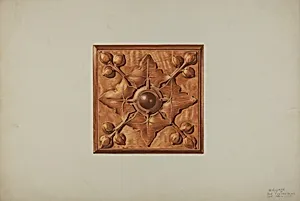
Mantel Carving
Medium
watercolor and graphite on paperboard
Dimensions
overall: 38.3 x 55.9 cm (15 1/16 x 22 in.) Original IAD Object: 8" approx.
Classification
Index of American Design
Department
CG-W
Museum
National Gallery of Art, Washington, D.C.
Credit
Index of American Design
Accession Number
1943.8.12784
Rights
Public Domain
Art Historical Context
**Mantel Carving**1939) is a delicate watercolor and graphite rendering by artist Michael Riccitelli, the intricate details of an American mantel carving. Measuring 38.3 x 55.9 cm (15 1/16 x 22 in.), this work on paperboard depicts an original object approximately 8 inches in, showcasing Riccitelli's skill in translating three-dimensional craftsmanship into a vibrant, two-dimensional study. The combination of watercolor's soft luminosity and graphite's precise lines highlights the carving's textures and ornamental motifs, making the everyday architectural element come alive on the page. Created as part of the Index of American Design—a groundbreaking Works Progress Administration (WPA) project from the late 1930s—this artwork reflects a national effort during the Great Depression to document and celebrate America's folk art, crafts, and decorative traditions. Riccitelli, one of over 200 artists involved, contributed to this vast visual archive now housed at the National Gallery of Art, preserving objects that might otherwise fade from memory. The piece underscores the cultural importance of mantel carvings in American homes, often handcrafted with neoclassical or folk-inspired details symbolizing hearth and home. By meticulously rendering its curves and patterns, Riccitelli not only honors regional artistry but also invites us to appreciate the ingenuity of everyday American design. A true gem of 20th-century preservation! (198 words)
About the Artist
Michael Riccitelli · 1855–present
**Michael Riccitelli** (American, active c. 1935) was a skilled draftsman whose precise watercolor renderings captured the essence of American folk art during the Great Depression era. Little is known about his early life or formal training, as biographical details remain scarce. He gained prominence through his contributions to the Index of American Design (IAD), a Works Progress Administration (...