
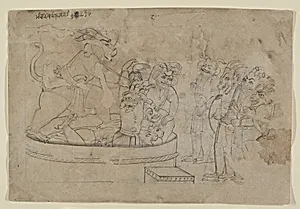
Mara Bringing the Demons to Life
mid-18th century
Medium
Ink and wash on paper
Dimensions
Image (sight): 8 1/2 x 12 1/8 in. (21.6 x 30.8 cm)
Classification
Paintings
Culture
India (Pahari Hills, Guler)
Department
Asian Art
Museum
Metropolitan Museum of Art, New York, NY
Credit
Gift of Subhash Kapoor, in memory of his parents, Smt Shashi Kanta and Shree Parshotam Ram Kapoor, 2008
Accession Number
2008.359.5
Rights
Public Domain
Tags
Art Historical Context
This evocative ink-and-wash drawing, created in the mid-18th century in Guler in the Pahari Hills of northern India, captures a dramatic moment from Buddhist legend. Attributed to Manaku of the Seu family, a master of the Guler school, the work depicts Mara, the embodiment of temptation, summoning demonic forces to disrupt the Buddha’s path to enlightenment. Such narrative scenes were popular in Pahari courts, where artists blended local storytelling traditions with refined visual language to convey spiritual themes. Executed in delicate ink washes on paper, the medium allowed Manaku to achieve fluid lines and subtle tonal gradations that heighten the sense of movement and otherworldly energy. The Guler style is celebrated for its naturalistic figures and emotional expressiveness, qualities that distinguish it within the broader tradition of Indian miniature painting. This sheet likely formed part of a larger series illustrating the Buddha’s life, reflecting the region’s deep engagement with Buddhist narratives during a period of artistic flourishing. Today in the Metropolitan Museum’s collection, the drawing offers visitors a glimpse into the rich cultural exchange between courtly patronage and religious devotion that shaped Pahari art. Its intimate scale invites close looking, rewarding viewers with details of Mara’s menacing entourage rendered through masterful economy of line.
About the Artist
Seu Family|Manaku ( |Indian) · |1715 – |1770
|Indian, active ca. 1725–60