
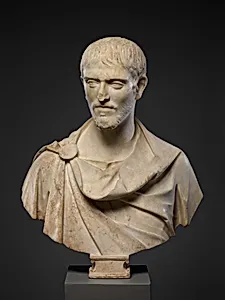
Marble portrait bust of a man
Unknown Artist
mid–3rd century CE
Medium
Marble
Dimensions
H. 25 7/8 in. (65.7 cm)
Classification
Stone Sculpture
Culture & Period
Roman · Late Imperial
Department
Greek and Roman Art
Museum
Metropolitan Museum of Art, New York, NY
Credit
Rogers Fund, 1908
Accession Number
08.258.46
Rights
Public Domain
Tags
Art Historical Context
This striking marble portrait bust of an unidentified man, carved in the mid-3rd century CE Rome's Late Imperial period, the essence of Roman individualism. Standing at 25⅞ inches tall, the sculpture exemplifies the enduring tradition of portraiture, where elites commissioned such busts for funerary monuments, public display, or private veneration. Acquired by the Metropolitan Museum of Art through the Rogers Fund in 8, it now resides in the Greek and Roman Art department, a window into a turbulent era marked by political upheaval and cultural shifts. Roman portrait busts like this one were masterful feats of stone sculpture, hewn from fine marble to convey lifelike details—textured hair, furrowed brows, and resolute gazes—that reflected the sitter's status, character, and ancestry. By the 3rd century, artistic styles evolved from the hyper-realistic verism of earlier Republican portraits toward more stylized features, blending classical idealism with expressive realism amid the empire's challenges. This piece likely honored a prominent figure, underscoring how such works served as eternal memorials in a society that prized legacy. Visitors to the Met can appreciate how this anonymous masterpiece highlights the technical prowess of Roman sculptors, who drilled intricate locks of hair and smoothed flesh-like surfaces, making the stone breathe with humanity. It's a testament to the cultural reverence for the human form in antiquity.