
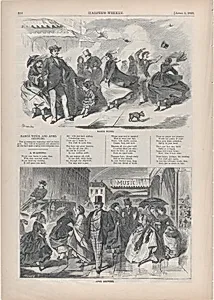
March Winds (from "Harper's Weekly," Vol. III)
April 2, 1859
Medium
Wood engraving
Dimensions
image: 5 7/8 x 9 1/8 in. (14.9 x 23.2 cm) sheet: 15 15/16 x 11 1/4 in. (40.5 x 28.5 cm)
Classification
Prints
Department
Drawings and Prints
Museum
Metropolitan Museum of Art, New York, NY
Credit
Harris Brisbane Dick Fund, 1936
Accession Number
36.13.6(1)
Rights
Public Domain
Tags
Art Historical Context
Winslow Homer's *March Winds*, published in *Harper's Weekly* April 2, 1859, captures the raw energy of a blustery spring day. As a young illustrator for the prominent American periodical, Homer contributed vivid wood engravings that brought everyday scenes to life for a national audience. This early work, from Volume III of the magazine, depicts men and women braving fierce winds and rain—likely urban pedestrians caught in nature's sudden fury—highlighting Homer's emerging talent for portraying human resilience amid the elements. Printed as a wood engraving, the image measures 5 7/8 x 9 1/8 inches on a larger sheet, a format ideal for the era's mass-produced newspapers. Wood engraving, a precise relief printing technique using end-grain boxwood blocks, allowed for intricate details like swirling gusts and billowing skirts, which convey motion and drama. This medium was revolutionary for 19th-century journalism, enabling affordable, high-quality illustrations that democratized visual storytelling. Homer's piece reflects mid-19th-century American life, blending realism with subtle humor in the struggle against unpredictable weather. Now in the Metropolitan Museum of Art's Drawings and Prints department (Harris Brisbane Dick Fund, 1936), it foreshadows his later mastery of atmospheric effects in paintings, marking a pivotal step in his career from illustrator to iconic artist.
About the Artist
Winslow Homer|Harper & Brothers|Harper's Weekly · 1836–1910
Winslow Homer (1836-1910) was one of America's greatest painters and a preeminent figure in 19th-century American art. Largely self-taught, Homer began his career as a commercial illustrator and Civil War correspondent for Harper's Weekly before becoming renowned for his powerful marine subjects and landscape paintings. His mastery of both oil and watercolor, combined with his uncompromising reali...