
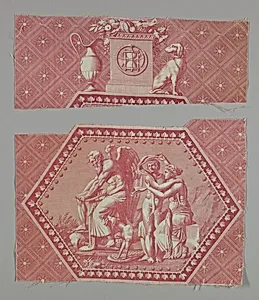
Marchand d'Amour
Classification
printed, dyed & painted textiles
Department
Smithsonian Collection
Museum
Smithsonian American Art Museum
Credit
Museum purchase through gift of Mrs. George B. McClellan
Accession Number
1906-15-6-a,b
Rights
Public Domain
About this artwork
Research in Progress
Art Historical Context
**Marchand d'Amour** (*Merchant of Love*), created around 1820 by French textile Hippolyte Le Bas (2–1867), the whimsical spirit of early 19th-century decorative arts. Le Bas, a pioneer in the burgeoning field of industrial textile printing, likely depicted a playful scene involving Cupid or love-themed figures peddling affection—a nod to neoclassical motifs infused with romantic charm. This printed, dyed, and painted textile the fusion of artistry and emerging manufacturing techniques during France's post-Napoleonic era, when sumptuous fabrics adorned bourgeois homes. The work's classification highlights innovative methods: roller-printing for bold patterns, vibrant dyes for color depth, and hand-painted details for refinement. These processes made high-quality textiles more accessible, reflecting a cultural shift toward affordable luxury and domestic elegance. Acquired through a museum purchase funded by Mrs. George B. McClellan, it now resides in the Smithsonian American Art Museum's collection, bridging European design influences with American tastes. Though research continues, *Marchand d'Amour* invites visitors to appreciate how textiles wove storytelling into everyday life, blending fantasy with craftsmanship in an age of artistic transition. (178 words)