
Mariae, D.G. Angliae, Franciae et Hiberniam Reginae (Mary I)
1551 to 1600
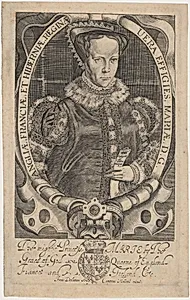
Medium
engraving
Dimensions
plate: 20.3 × 12.3 cm (8 × 4 13/16 in.)
Classification
Department
CG-E
Museum
National Gallery of Art, Washington, D.C.
Credit
Rosenwald Collection
Accession Number
1950.14.836
Rights
Public Domain
Art Historical Context
Behold this striking engraving titled *Mariae, D.G. Angliae, Franc et Hiberniam Reg (Mary I)*, a Latin inscription proclaiming "Mary, by the Grace of God Queen of England, France and Ireland." Created by English engraver Francis Del between 1551 and1600, it captures the likeness of Mary I, England's first reigning queen (1553–1558), during a turbulent era of religious upheaval and royal transition. Delaram, known for his precise portrait engravings, employed the intaglio technique, incising fine lines into a metal plate to produce rich, detailed prints from ink trapped in the grooves. Measuring just 20.3 × 12.3 cm, this intimate plate exemplifies the Renaissance-era fascination with reproducible royal imagery, allowing Mary's stern visage and regal attire to circulate widely among elites and collectors. Such prints served propaganda purposes, reinforcing monarchic authority amid the Reformation's Protestant shift. Housed in the National Gallery of Art's Rosenwald Collection (Department CG-E), this work highlights engraving's role in preserving Tudor history. Mary's reign, marked by her Catholic restorations and marriage to Philip II of Spain, remains controversial—yet here, Delaram immortalizes her unyielding sovereignty in enduring black lines. A testament to art's power in shaping legacy.
About the Artist
Francis Delaram · 1590–1627
Francis Delaram (c. 1590–1627) was a prolific English engraver active in London during the early Jacobean era, producing several hundred plates that captured the likenesses of monarchs, nobles, and scholars. Flourishing from around 1615, he specialized in line engravings for portraits, title pages, and book illustrations, often working after prominent painters. His output contributed significantly...