
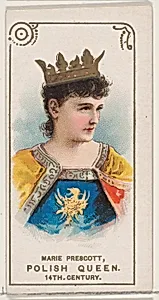
Marie Prescott Dressed as Polish Queen of the 14th Century, from the set Actors and Actresses, Second Series (N71) for Duke brand cigarettes
Medium
Commercial color lithograph
Dimensions
Sheet: 2 3/4 x 1 1/2 in. (7 x 3.8 cm)
Classification
Prints|Ephemera
Department
Drawings and Prints
Museum
Metropolitan Museum of Art, New York, NY
Credit
The Jefferson R. Burdick Collection, Gift of Jefferson R. Burdick
Accession Number
63.350.204.71.21
Rights
Public Domain
Art Historical Context
This small cigarette card presents a vibrant portrait of actress Marie Prescott in costume as a fourteenth-century Polish queen. She appears in three-quarter view against a softly mottled blue background, her dark curls framing a face turned slightly to the right. A golden crown studded with red stones rests on her head, while her blue bodice bears a prominent golden eagle and is trimmed with ornate silver and gold patterns; the yellow sleeves add a warm contrast within the narrow rectangular frame. The image is a commercial color lithograph produced between 1888 and 1890 by W. Duke, Sons & Co. in collaboration with Knapp & Company as part of the Actors and Actresses, Second Series (N71) issued with Duke brand cigarettes. Such cards were popular promotional inserts that brought portraits of celebrated performers into everyday hands. Now preserved in the Metropolitan Museum’s Burdick Collection, the print illustrates how late-nineteenth-century advertising merged theatrical celebrity with colorful, accessible graphic art.
About the Artist
W. Duke, Sons & Co.|Knapp & Company · 1870–1920
**W. Duke, Sons & Co.: Pioneers of Chromolithographic Trade Card Art** W. Duke, Sons & Co., an American tobacco manufacturer, emerged from the entrepreneurial vision of Washington Duke (1820–1905) and his sons in Durham, North Carolina. After the Civil War, Washington abandoned farming in 1874 to join his eldest son, Brodie L. Duke, in the burgeoning tobacco trade, establishing a factory that for...