
Marine Scene (recto)
1870–85
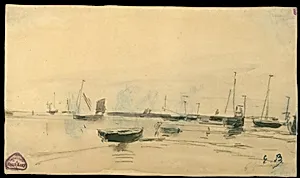
Medium
Watercolor over graphite on tan wove paper
Dimensions
5 1/4 x 9 1/16 in. (13.4 x 23 cm)
Classification
Drawings
Department
Robert Lehman Collection
Museum
Metropolitan Museum of Art, New York, NY
Credit
Robert Lehman Collection, 1975
Accession Number
1975.1.575
Rights
Public Domain
Tags
Art Historical Context
Eugène Boudin, a pioneering French artist often hailed as a precursor to Impressionism, captures the fleeting beauty of the sea inMarine Scene (recto, created between 1870 and 1885. Known for his luminous beach and harbor scenes painted en plein air along the Normandy coast, Boudin sketched directly from nature, emphasizing atmospheric effects like shifting light and wind-swept skies. This drawing depicts boats on the water, evoking the bustling maritime life of 19th-century France. Rendered in watercolor over graphite on tan wove paper, the work measures just 5¼ x 9⅛ inches, highlighting Boudin's mastery of mixed media for rapid, expressive studies. The tan paper provides a warm underpainting that enhances the transparency of watercolor washes, allowing subtle gradations of blue and gray to mimic sea foam and distant horizons. Such techniques influenced younger artists like Claude Monet, whom Boudin mentored. Housed in the Robert Lehman Collection at The Metropolitan Museum of Art since 1975, this piece exemplifies Boudin's role in bridging Romanticism and modernism. Visitors can appreciate how his quick notations preserve the ephemeral drama of coastal scenes, inviting us to feel the salt spray and hear the gulls.
About the Artist
Eugène Boudin · 1824–1898
Eugène Louis Boudin was born on July 12, 1824, in Honfleur, Normandy, the son of a harbor pilot. When his family relocated to Le Havre, his father opened a stationery and picture-framing shop, and it was there that the young Boudin first encountered working artists. Artists such as Constant Troyon and Jean-François Millet recognized his talent and urged him toward a career in art. In 1850, a munic...