
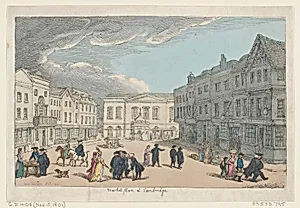
Market Place at Cambridge
November 15, 1801
Medium
Hand-colored etching
Dimensions
Sheet: 6 3/4 × 9 13/16 in. (17.1 × 25 cm)
Classification
Prints
Department
Drawings and Prints
Museum
Metropolitan Museum of Art, New York, NY
Credit
The Elisha Whittelsey Collection, The Elisha Whittelsey Fund, 1959
Accession Number
59.533.795
Rights
Public Domain
Tags
Art Historical Context
Thomas Rowlandson's *Market Place at Cambridge*, a hand-colored etching dated November15, 1801, captures the lively bustle of everyday life in early 19th-century England This intimate sheet (6 3/4 × 9 13/16 in.) depicts a vibrant market scene filled with men women, buildings, and energy, offering a window into the social fabric of Cambridge. Rowlandson, a master of British caricature and satire, was renowned for his humorous, exaggerated portrayals of ordinary folk, blending sharp observation with whimsical charm. As a hand-colored etching, the work showcases Rowlandson's skill in the printmaking techniques popular during the Georgian era. Etching allowed for detailed line work etched into copper plates, while the added watercolor heightened the vividness, making these affordable prints appealing to a wide audience beyond elite collectors. This piece exemplifies the era's booming market for satirical prints, which commented on class, commerce, and city life. Housed in the Metropolitan Museum of Art's Drawings and Prints department (The Elisha Whittelsey Collection, 1959), *Market Place at Cambridge* preserves a snapshot of Regency England's communal heart—the marketplace—as a hub of trade, gossip, and human interaction, inviting us to linger on its timeless energy.
About the Artist
Thomas Rowlandson · 1756–1827
Thomas Rowlandson (1757–1827) was an English artist and caricaturist whose satirical watercolors and prints captured the social life of Georgian Britain with unparalleled wit and technical mastery. Alongside James Gillray, he is recognized as one of the greatest British graphic artists, and his distinctive flowing line and keen observations have made his work integral to understanding late 18th an...