
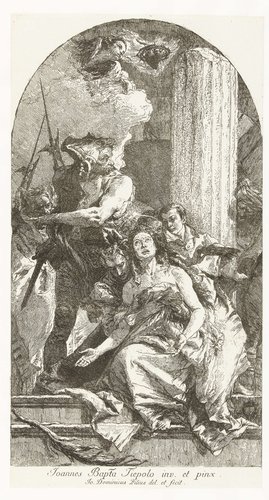
Martelaarschap van Heilige Agatha
1753 - 1757
Medium
etching
Dimensions
434; 233
Rights
Public Domain
About this artwork
ets en gravure
Art Historical Context
Giovanni Domenico Tiepolo's *Martelaarschap van Heilige Agatha (Martyrdom of Saint Agatha), created between 1753 and 1757, captures a dramatic moment from the life of the 3rd-century Sicilian saint, who endured brutal torture for her Christian faith. As the son of the renowned Venetian Rococo master Giovanni Battista Tiepolo,andomenico inherited his father's flair for theatrical compositions, light effects, and emotional intensity. This etching exemplifies the younger Tiepolo's skill in translating the opulent, dynamic style of Venetian painting into print form, making grand religious narratives accessible to a wider audience. Saint Agatha's martyrdom, famously involving the severing of her breasts, symbolized purity and resilience in Baroque and Rococo art, often evoking both horror and piety. Tiepolo's interpretation likely draws from traditional iconography, emphasizing her serene endurance amid tormentors, a theme popular in 18th-century Catholic Europe amid Counter-Reformation fervor. Produced during Giandomenico's formative years in Venice, the work reflects the Tiepolo workshop's blend of fantasy and realism. Rendered as an etching and engraving on a grand scale (434 × 233 mm), this print showcases Tiepolo's mastery of intaglio techniques: acid-etched lines for fluid shading and burin-engraved details for crisp precision. Etchings like this were prized for their reproducibility, allowing devotional images to adorn homes and chapels, bridging elite art with popular devotion. A poignant reminder of faith's trials, it invites viewers to ponder endurance in the face of suffering.
About the Artist
Giovanni Domenico Tiepolo · 1727–1804
Giovanni Domenico Tiepolo (1727-1804) was a Venetian painter, printmaker, and draftsman whose career spanned the twilight of the Rococo era. Born on August 30, 1727, in Venice as the eldest son of the celebrated Giovanni Battista Tiepolo, he worked both in his father's shadow and as a significant independent artist who developed a distinctly earthbound and humanistic vision. Domenico's importance...