
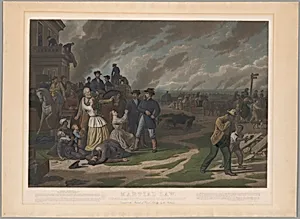
Martial Law
1872
Medium
Hand-colored engraving and etching in black, with selective glazing, on ivory wove paper
Dimensions
Sight: 62 × 81 cm (24 7/16 × 31 15/16 in.)
Classification
Department
Prints and Drawings
Museum
Art Institute of Chicago
Accession Number
266146
Rights
Public Domain
Art Historical Context
John Sartain’s 1872 print *Martial Law* exemplifies the refined reproductive engraving techniques that flourished in the nineteenth century. Working in hand-colored engraving and etching with selective glazing on ivory wove paper, Sartain translated dramatic subject matter into a large-scale format measuring roughly 24 by 32 inches. Such meticulous processes allowed subtle tonal gradations and vibrant accents, giving the print the richness of a painting while remaining accessible to a broader audience through the print medium. Created in the years following the American Civil War, the title evokes the tense atmosphere of Reconstruction, when military authority remained a charged national issue. Sartain, a leading Philadelphia engraver and publisher, often chose topical themes that resonated with contemporary viewers. The careful coloring and glazing not only heightened emotional impact but also demonstrated the technical sophistication of American printmaking at mid-century. Today, this work in the Art Institute of Chicago’s collection invites reflection on how prints shaped public understanding of pivotal historical moments. Its impressive scale and refined execution remind us that engraving was both an art form and a powerful vehicle for social commentary.
About the Artist
John Sartain · 1808–1897
**John Sartain (1808–1897)** was an English-born American artist renowned for pioneering mezzotint engraving in the United States. Born in London on October 24, 1808, he trained in line engraving and contributed plates to William Young Ottley’s *Early Florentine School* (1826). He began experimenting with mezzotints in 1828 and studied painting under John Varley and Henry James Richter. In 1830, a...