
Martino
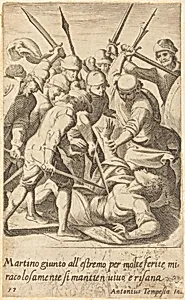
Medium
engraving on laid paper
Dimensions
sheet (trimmed to plate mark): 13.2 × 8.2 cm (5 3/16 × 3 1/4 in.)
Classification
Department
CG-E
Museum
National Gallery of Art, Washington, D.C.
Credit
R.L. Baumfeld Collection
Accession Number
1969.15.335
Rights
Public Domain
Art Historical Context
Created in 1619, “Martino” a fine example of early seventeenth-century printmaking. Jacques Callot, working after a design by the Italian artist Antonio Tempesta, translated the original composition into a precise engraving on laid paper. At just 13.2 × 8.2 cm, the print’s modest scale was typical of Callot’s output, allowing the image to circulate easily among collectors and scholars across Europe. Engraving offered remarkable clarity and durability, enabling artists to reproduce paintings and drawings with remarkable fidelity. Callot’s technical mastery—evident in the crisp lines and subtle tonal gradations—helped elevate the medium from mere reproduction to an independent art form. Such prints played an important role in spreading artistic ideas during the Baroque period, when travel and published images connected distant courts and workshops. Today this impression, part of the National Gallery of Art’s R.L. Baumfeld Collection, preserves both Tempesta’s original vision and Callot’s distinctive skill, offering visitors a window into the vibrant world of seventeenth-century European print culture.