
Rocco
Medium
engraving on laid paper
Dimensions
sheet ([irreg.] trimmed to plate mark): 13 × 7.9 cm (5 1/8 × 3 1/8 in.)
Classification
Department
CG-E
Museum
National Gallery of Art, Washington, D.C.
Credit
R.L. Baumfeld Collection
Accession Number
1969.15.318
Rights
Public Domain
Art Historical Context
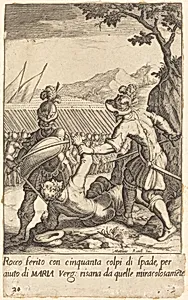
Behold the exquisite engraving *Rocco*, created in 1619 by master printmaker Jacques Callot after design by Florentine painter Matteo Rosselli This small-scale work (just 13 × 7.9 cm) depicts Saint Rocco, the beloved protector against plague, whose cult surged in Europe amid recurring epidemics. Callot, a pioneering Baroque engraver known for his intricate detail and dynamic compositions, faithfully translated Rosselli's painted original into print, bridging painting and printmaking traditions of early 17th-century Italy and France. Crafted as an engraving on laid paper—a period staple with its distinctive chain lines visible under light—*Rocco* showcases Callot's virtuoso technique. He meticulously incised fine lines into a metal plate, capturing the saint's pious gesture, flowing drapery, and emotive expression with remarkable precision. Such engravings were revolutionary, allowing widespread dissemination of devotional images to pilgrims and collectors beyond elite patrons. Housed in the National Gallery of Art's R.L. Baumfeld Collection (Department CG-E), this trimmed sheet exemplifies the era's fusion of religious fervor and artistic innovation. In a time of hardship, it offered solace and artistry, reminding us how prints democratized sacred imagery for everyday devotion.