
Maruru
1893–94
Medium
Woodcut on China paper
Dimensions
block: 8 x 14 in. (20.3 x 35.6 cm) sheet: 10 3/8 x 17 in. (26.4 x 43.2 cm)
Classification
Prints
Department
Drawings and Prints
Museum
Metropolitan Museum of Art, New York, NY
Credit
Rogers Fund, 1921
Accession Number
21.38.3
Rights
Public Domain
Tags
Art Historical Context
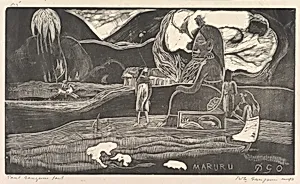
**Maruru**, a captivating woodcut created by Paul Gauguin between 1893 and 1894, offers a glimpse into the artist's immersive experience in Tahiti. Printed on delicate China paper, this intimate work measures about 8 by 14 inches and depicts a serene South Seas scene with human figures, thatched houses, and lush trees. Gauguin, a Post-Impressionist pioneer, captured the exotic simplicity of Polynesian village life, drawing from his time on the island where he sought inspiration away from European conventions. During his first Tahitian sojourn (1891–93), Gauguin experimented boldly with printmaking, producing a small suite of woodcuts like *Maruru*—part of his *Noa Noa* project, inspired by his journal of the same name. He carved the blocks himself, using rough, expressive lines and hand-rubbed ink to evoke a primal, flattened perspective influenced by Japanese ukiyo-e prints and local wood traditions. The thin China paper enhances the texture, allowing ink to seep through for a luminous, almost sculptural effect. Acquired by the Metropolitan Museum of Art via the Rogers Fund in 1921, *Maruru* exemplifies Gauguin's primitivist vision, blending Western technique with Oceanic motifs. It highlights his quest for cultural authenticity and remains a key example of how he bridged fine art and print media, influencing modern artists like the Fauves and Expressionists. Visitors, imagine the humid island breeze as you trace these bold forms!
About the Artist
Paul Gauguin · 1848–1903
Paul Gauguin (1848-1903) was a French Post-Impressionist painter whose bold experiments with color, form, and subject matter made him one of the most influential figures in the transition from 19th-century art to modernism. His rejection of European civilization for the perceived authenticity of 'primitive' cultures established an archetype of artistic exile that continues to resonate. Gauguin's ...