
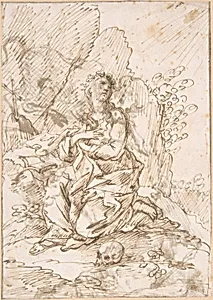
Mary Magdalen in the Wilderness
Medium
Pen and brown ink on cream paper. Fragmentary framing outlines in pen and ink on left, top, right edges
Dimensions
6-3/4 x 8-5/16 in. (17.2 x 21.1 cm)
Classification
Drawings
Department
Drawings and Prints
Museum
Metropolitan Museum of Art, New York, NY
Credit
Gift of Cephas G. Thompson, 1887
Accession Number
87.12.162
Rights
Public Domain
Tags
Art Historical Context
This delicate 17th-century drawing, *Mary Magdalen in the*, captures the penitent saint in a moment of profound contemplation amid a rugged landscape. Created by an anonymous artist from the Roman-Bnese school, it reflects the Baroque era's fascination with dramatic religious themes and emotional depth. Mary Magdalene, often portrayed as a hermit after Christ's resurrection, is shown with her iconic attributes—a skull symbolizing mortality and a cross evoking redemption—emphasizing themes of repentance and divine grace that resonated deeply in Counter-Reformation Italy. Executed in pen and brown ink on cream paper, the work showcases the meticulous line work typical of Italian draftsmanship, where fluid strokes convey texture, shadow, and spiritual intensity. The fragmentary framing outlines on three edges suggest it may be a surviving study or preparatory sheet, highlighting the preparatory role of drawings in 17th-century workshops. At just 6-3/4 x 8-5/16 inches, its intimate scale invites close viewing, revealing the artist's skillful economy of line. A gift to the Metropolitan Museum of Art in 1887 from Cephas G. Thompson, this piece offers a window into devotional art's cultural power, blending personal piety with artistic virtuosity for patrons seeking solace in saints' stories.