
Mary Magdalen in the wilderness
ca. 1613–14
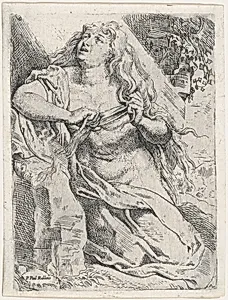
Medium
Etching; second state of three (Hollstein)
Dimensions
Plate: 5 3/16 × 4 1/16 in. (13.1 × 10.3 cm) Sheet: 5 13/16 × 4 7/16 in. (14.7 × 11.2 cm)
Classification
Prints
Department
Drawings and Prints
Museum
Metropolitan Museum of Art, New York, NY
Credit
Harris Brisbane Dick Fund, 1927
Accession Number
27.82.9
Rights
Public Domain
Tags
Art Historical Context
In the early 17th century, Baroque master Peter Paul Rubens collaborated with Dutch engraver Willem Pietersz Buytewech to *Mary Magdalen in the* (ca. 1613–14), a poignant etching capturing the penitent saint in contemplative solitude. Rubens, renowned for his dynamic and sensual figures, likely provided the design, while Buywech executed the meticulous etching—a technique where acid etches intricate lines into a copper plate, allowing for rich tonal effects and subtle textures ideal for expressing spiritual depth. This second state of three (per Hollstein catalog) measures a intimate plate size of just 5 3/16 × 4 1/16 inches, making it a gem for collectors and a means to disseminate Rubens' artistry beyond paintings. During the Counter-Reformation, images of Mary Magdalene, often shown in wild landscapes with symbols of repentance, reinforced Catholic devotion and human vulnerability, blending eroticism with piety in Baroque fashion. Housed in the Metropolitan Museum of Art's Drawings and Prints department (Harris Brisbane Dick Fund, 1927), this print exemplifies how Rubens' grand vision scaled to printmaking, bridging Antwerp's vibrant art scene with wider European audiences. A testament to collaborative genius, it invites viewers to ponder the saint's inner wilderness.
About the Artist
Peter Paul Rubens|Willem Pietersz. Buytewech · 1577–1640
Peter Paul Rubens (1577-1640) stands as the most influential artist of the Flemish Baroque tradition and the greatest exponent of Baroque painting's dynamism, vitality, and sensuous exuberance. Born in Siegen, Westphalia, and raised in Antwerp, Rubens received a humanist education studying Latin and classical literature before pursuing artistic training under three masters: Tobias Verhaecht, Adam ...