
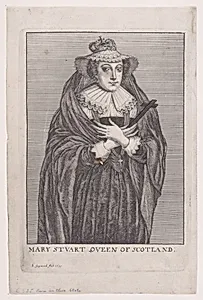
Mary, Queen of Scots
Medium
Etching
Dimensions
Plate: 8 5/16 × 5 13/16 in. (21.1 × 14.8 cm) Sheet: 9 13/16 × 6 1/2 in. (25 × 16.5 cm)
Classification
Prints
Department
Drawings and Prints
Museum
Metropolitan Museum of Art, New York, NY
Credit
Gift of Susan Dwight Bliss, 1958
Accession Number
58.549.23
Rights
Public Domain
Tags
Art Historical Context
This etching, titled *Mary, Queen of Scots and dated 1655, captures the tragic Tudor monarch in a striking posthumous portrait. Attributed to French Baroque artist Claude Vignon, possible involvement from English printmaker Richard Gaywood, exemplifies 17th-century fascination with Mary's dramatic life. Vignon, known for his eclectic style blending mannerism and emerging classicism, likely provided the design, while the etching technique—pioneered for its fluid lines and tonal depth—allowed for intricate details in her lace collar, jewelry, and somber expression. Mary Stuart (1542–1587), Queen of Scots from infancy, embodied Renaissance intrigue: a Catholic claimant to the English throne, she navigated alliances, scandals, and imprisonment before her execution by Elizabeth I. Created nearly seven decades after her death, this print reflects her enduring mythic status in European culture, romanticized in literature and art as a symbol of beauty, piety, and misfortune. Housed in the Metropolitan Museum of Art's Drawings and Prints department, this modest yet evocative work (plate: 8 5/16 × 5 13/16 in.) highlights etching's role in democratizing portraiture, making royal icons accessible beyond oil paintings. A gift from Susan Dwight Bliss in 1958, it invites visitors to ponder Mary's legacy amid the Baroque era's theatrical flair.
About the Artist
Claude Vignon|Mary, Queen of Scots|Richard Gaywood · 1593–1670
Claude Vignon was born on May 19, 1593, in Tours, France, into a wealthy family, and he died on May 10, 1670, in Paris. He received his initial artistic training in Paris under the Mannerist painter Jacob Bunel, a key figure in the Second School of Fontainebleau. Vignon traveled extensively in his youth, likely visiting Rome as early as 1609–1610 and settling there by 1616–1619 among the French ar...