
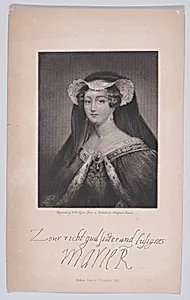
Mary, Queen of Scots
Medium
Reproductive engraving with lozenge and dot technique
Dimensions
Sheet: 8 3/16 × 5 1/16 in. (20.8 × 12.9 cm)
Classification
Prints
Department
Drawings and Prints
Museum
Metropolitan Museum of Art, New York, NY
Credit
Gift of Susan Dwight Bliss, 1958
Accession Number
58.549.172
Rights
Public Domain
Tags
Art Historical Context
This delicate reproductive engraving, titled *Mary, Queen of Scots* and created in 1835 by engraver William Home Lizars for publishers Fisher, Son & Co., captures the tragic Tudor-era monarch (1542–1587) in a portrait format. Measuring just 8 3/16 × 5 1/16 inches, it exemplifies 19th-century printmaking's role in democratizing access to historical icons, allowing middle-class Victorians to own affordable likenesses of royalty. Housed in the Metropolitan Museum of Art's Drawings and Prints department (gift of Susan Dwight Bliss, 1958), it reflects the era's fascination with Mary's dramatic life—from her French upbringing and Scottish reign to her imprisonment and execution by cousin Elizabeth I. The artwork employs the lozenge and dot technique, a refined stipple engraving method where diamond-shaped lozenges and fine dots build subtle tonal gradations, mimicking painting's softness without etching's harsh lines. This reproductive process faithfully copies an earlier portrait, highlighting engraving's precision for historical preservation. Mary's enduring image as a symbol of beauty, intrigue, and Catholic martyrdom made such prints culturally vital, fueling Romantic literature and nationalism. A poignant window into queenship and women's power struggles, it invites us to ponder her complex legacy.