
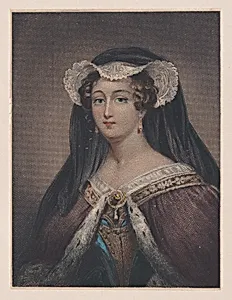
Mary, Queen of Scots
Medium
Hand-colored reproductive engraving with lozenge and dot technique
Dimensions
Sheet (trimmed): 4 5/8 × 3 7/16 in. (11.7 × 8.8 cm)
Classification
Prints
Department
Drawings and Prints
Museum
Metropolitan Museum of Art, New York, NY
Credit
Gift of Susan Dwight Bliss, 1958
Accession Number
58.549.454
Rights
Public Domain
Tags
Art Historical Context
This hand-colored engraving captures Mary, Queen of Scots (1542–1587), one of the most compelling figures in British history. Born into the Scottish throne as an infant, Mary’s life was marked by political intrigue, multiple marriages, and eventual imprisonment by her cousin Queen Elizabeth I, culminating in her execution in 1587. Created around 1833, long after her death, the print reflects the 19th-century fascination with romanticized historical heroines, presenting her as both a regal sovereign and a tragic woman. William Home Lizars, a Scottish engraver and publisher, produced this reproductive work using a lozenge and dot technique that allowed for delicate tonal shading and fine detail in small formats. Such prints were widely circulated to bring portraits of famous figures into homes and books, making Mary’s image accessible to a broader audience. Measuring just over four by three inches, the sheet’s intimate scale suggests it may have been intended for a private collection or an illustrated volume. Now in the Metropolitan Museum of Art’s Department of Drawings and Prints, this piece highlights how reproductive engravings helped shape public memory of historical women. Its gift from Susan Dwight Bliss in 1958 underscores the enduring appeal of Mary’s story across centuries.