
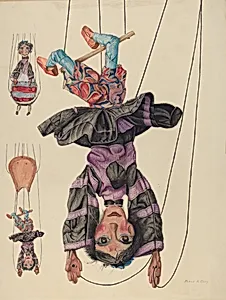
Marylin, the Trapeze Artist
1935/1942
Medium
watercolor and graphite on paperboard
Dimensions
overall: 51.2 x 38.1 cm (20 3/16 x 15 in.) Original IAD Object: 17" high
Classification
Index of American Design
Department
CG-W
Museum
National Gallery of Art, Washington, D.C.
Credit
Index of American Design
Accession Number
1943.8.16865
Rights
Public Domain
Art Historical Context
**Marylin, the Trapeze** is a captivating watercolor and graphite rendering by Frank Gray, created between 1935 and1942. This work depicts a dynamic folk art figure of a trapeze artist poised in mid-performance, measuring an original object height of 17 inches. Gray's precise drawing on paperboard (51.2 x 38.1 cm overall) captures the whimsical energy of American circus culture, likely inspired by 19th- or early 20th-century carved wooden sculptures that celebrated the era's popular entertainments. As part of the *Index of American Design* (IAD), a Federal Art Project under the Works Progress Administration during the Great Depression, this piece served a vital documentary purpose. Launched in 1935, the IAD employed artists like Gray to meticulously record everyday American design objects—from folk carvings to crafts—preserving cultural heritage amid economic hardship. Watercolor allowed for vibrant hues and subtle shading, while graphite added fine details, making these renderings both artistic achievements and historical records. Housed in the National Gallery of Art's collection, *Marylin* highlights the IAD's role in valuing vernacular art, reflecting America's love for spectacle and craftsmanship. Visitors will appreciate how Gray's skilled technique freezes a moment of daring grace, bridging folk tradition with professional artistry.
About the Artist
Frank Gray · 1889–1962
Frank Gray is an artist whose works are held in institutional collections, though comprehensive biographical information — including birth and death dates, nationality, and artistic training — remains difficult to establish from currently available sources. The relative obscurity of his biographical record is not uncommon among artists who worked outside the major metropolitan centers or the most ...