
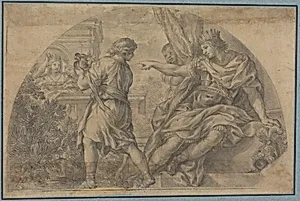
Masinissa and Sophonisba
1551 to 1600
Medium
black chalk
Dimensions
Overall: 20.9 x 31.4 cm (8 1/4 x 12 3/8 in.) support: 36.6 x 47.6 cm (14 7/16 x 18 3/4 in.)
Classification
Drawing
Department
CG-E
Museum
National Gallery of Art, Washington, D.C.
Credit
Julius S. Held Collection
Accession Number
1985.1.28
Rights
Public Domain
Art Historical Context
Behold *Masinissa and Sophonisba*, a captivating black chalk drawing from the Julius S. Held Collection at the National Gallery of Art. Created after the renowned Baroque master Pietro da Cortona (1596–1669), this work dates to between 1551 and 1600, capturing a dramatic moment from ancient history. It depicts the Numidian king Masinissa and the Carthaginian beauty Sophonisba, whose tragic romance during the Second Punic War inspired countless artists. In the story, Sophonisba, to evade Roman capture, drinks poison offered by her new husband Masinissa—a tale of love, loyalty, and betrayal that resonated in Renaissance and Baroque art for its emotional intensity. Executed in black chalk on a support measuring 36.6 x 47.6 cm (with the sheet itself 20.9 x 31.4 cm), this drawing exemplifies the medium's versatility. Black chalk allowed artists like those in Cortona's circle to achieve subtle tonal gradations, fluid lines, and dramatic chiaroscuro, ideal for preparatory studies or faithful copies of grand compositions. As a work "after" Cortona, it reflects his dynamic Baroque style—sweeping gestures and theatrical emotion—while serving as an important record of his influential designs. Housed in the National Gallery's Department CG-E, this piece offers visitors a window into 16th-17th century draftsmanship and the enduring allure of classical narratives in European art, blending historical drama with masterful technique.