
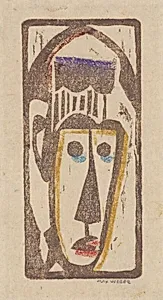
Mask
1919-1920
Medium
color woodcut on laid paper
Dimensions
image: 10.64 × 4.92 cm (4 3/16 × 1 15/16 in.) sheet: 23.65 × 16.99 cm (9 5/16 × 6 11/16 in.)
Classification
Department
CG-W
Museum
National Gallery of Art, Washington, D.C.
Credit
Gift of Jack and Margrit Vanderryn
Accession Number
2015.114.47
Rights
Public Domain
Art Historical Context
Max Weber's *Mask* (1919-1920) is a striking color woodcut on laid paper, capturing the modernist fascination with primitive forms during the post-World War I era. Measuring just 10.64 × 4.92 cm in its image area, this intimate print exemplifies Weber's exploration of Cubist and Expressionist influences. Born in Russia and active in New York's avant-garde scene, Weber drew inspiration from African and Oceanic art, much like his contemporaries Picasso and Matisse. The angular, abstracted visage evokes ritual masks, blending cultural motifs with geometric fragmentation to convey mystery and emotional depth. Printed on laid paper—a traditional support with visible chain lines that adds tactile authenticity—the woodcut technique highlights Weber's mastery of relief printing. Multiple woodblocks were likely carved and inked in vibrant hues to build layered colors and bold contours, a labor-intensive process that suited the era's emphasis on handmade artistry amid industrialization. This method allowed for the print's crisp textures and vivid contrasts, making it both accessible (via editions) and collectible. Housed in the National Gallery of Art as a gift from Jack and Margrit Vanderryn, *Mask* reflects the Jewish-American artist's synthesis of immigrant heritage and modern innovation. It invites visitors to ponder how early 20th-century artists reimagined global traditions, bridging continents in a single, powerful image.
About the Artist
Max Weber · 1881–1961
Max Weber (1881–1961), born in Białystok in the Russian Empire (now Poland) to Orthodox Jewish parents, immigrated to Brooklyn, New York, at age ten with his family, joining his tailor father.) There, he pursued art studies at the Pratt Institute under Arthur Wesley Dow, an innovative teacher who emphasized expression and form over traditional narrative, drawing from Japanese art and Paul Gauguin....